
Reverse Stock Split: Historical Analysis and Impact
Understanding corporate actions that reshape equity structures requires examining both their mechanical execution and historical context. A reverse stock split represents one of the most misunderstood yet strategically significant corporate maneuvers in financial markets. This action consolidates existing shares into fewer, higher-priced shares without changing the company's total market capitalization. Throughout financial history, companies have employed this tool for various reasons, from maintaining exchange listing compliance to reshaping investor perception. By examining past implementations and their outcomes, investors and analysts can better understand the motivations behind these decisions and their potential implications for shareholders.
Understanding the Mechanics of Reverse Stock Splits
A reverse stock split fundamentally alters the number of outstanding shares while proportionally adjusting the share price. When a company executes a 1-for-10 reverse stock split, every ten shares an investor owns becomes one share, with the price theoretically increasing tenfold. The total value of an investor's holdings remains unchanged immediately following the split.
The mathematical simplicity masks the complexity of strategic considerations. Companies must file detailed proposals with regulatory bodies, obtain board approval, and often secure shareholder consent before implementation. The process involves specific record dates, effective dates, and detailed communication to ensure all stakeholders understand the changes.
Key Components of the Process
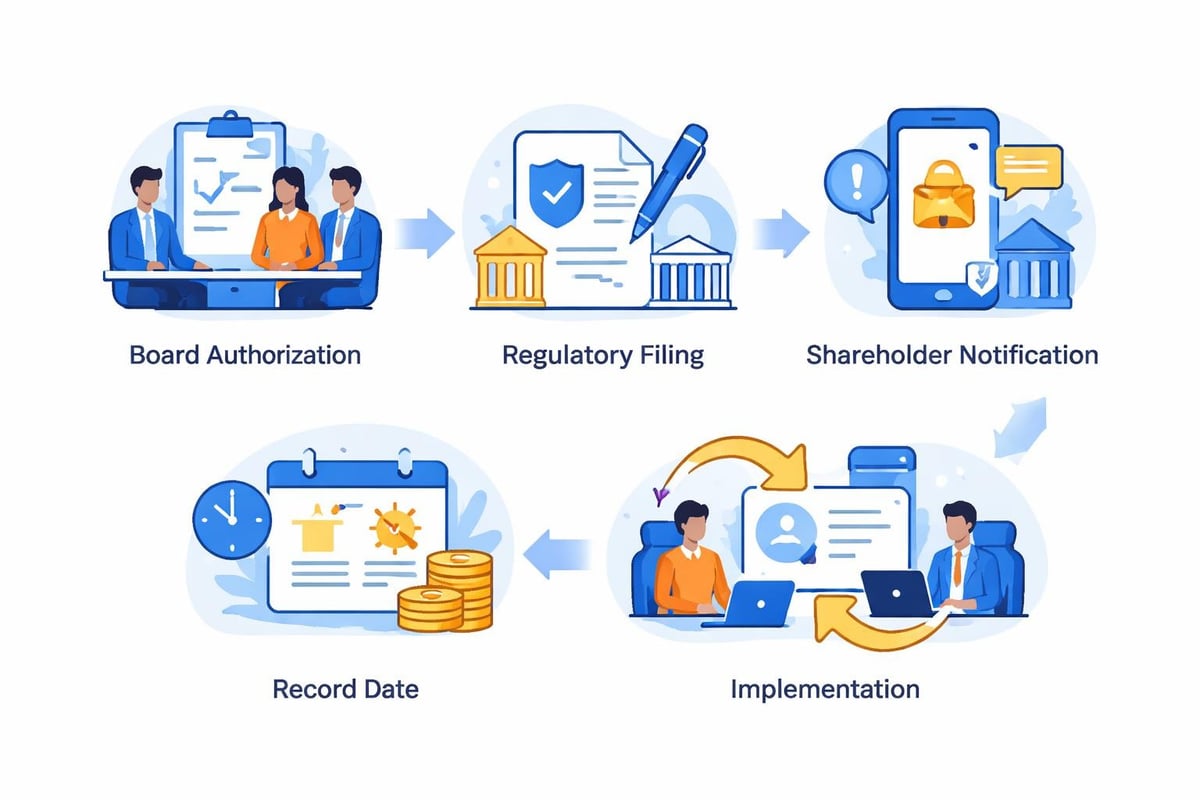
The execution of a reverse stock split involves several critical stages:
- Board authorization determining the split ratio and timeline
- Regulatory filing with the Securities and Exchange Commission
- Shareholder notification explaining the rationale and mechanics
- Record date establishment identifying affected shareholders
- Implementation through transfer agents and depositories
Exchange requirements play a crucial role in these decisions. The NYSE's proposed rule changes to limit reverse stock splits reflect growing concerns about companies using this mechanism primarily to maintain listing standards without addressing underlying business challenges.
Historical Motivations Behind Reverse Stock Splits
Throughout market history, companies have pursued reverse stock splits for distinct strategic reasons. The most common motivation involves maintaining compliance with minimum share price requirements set by major exchanges. Both NYSE and Nasdaq require listed companies to maintain minimum bid prices, typically one dollar, to avoid delisting.
Listing Compliance Recovery
When share prices fall below exchange minimums, companies face potential delisting to over-the-counter markets. This relegation typically reduces liquidity, increases trading costs, and diminishes institutional investor interest. Historical data shows that companies often execute reverse splits as a last-resort measure to preserve their listing status. The recent regulatory updates regarding reverse stock splits have introduced stricter oversight to ensure these actions serve legitimate business purposes.
Perception Management and Investor Psychology
Beyond technical compliance, companies sometimes pursue reverse splits to influence market perception. Low-priced stocks, particularly those trading below five dollars, often carry negative stigma associated with speculative "penny stocks." Management teams may believe that elevating share prices creates a more professional image and attracts different investor demographics.
| Historical Period | Primary Motivation | Success Rate | Market Reaction |
|---|---|---|---|
| 1980s-1990s | Listing compliance | 45% | Generally negative |
| 2000-2008 | Perception management | 38% | Mixed results |
| 2009-2020 | Post-crisis recovery | 42% | Context-dependent |
| 2021-2026 | Regulatory compliance | 40% | Increasingly scrutinized |
Historical analysis reveals that market reactions to reverse stock splits have remained predominantly negative across decades. Investors often interpret these actions as signals of financial distress rather than strategic repositioning. Understanding these patterns through platforms like Historic Financial News helps contextualize current corporate decisions within broader market trends.
Notable Historical Examples and Their Outcomes
Examining specific cases provides valuable insights into how reverse stock splits unfold in practice. The technology sector has seen numerous high-profile examples, particularly during periods of market downturn when share prices plummeted.
Citigroup's 2011 Reverse Split
Following the 2008 financial crisis, Citigroup implemented a 1-for-10 reverse stock split in May 2011. The banking giant's shares had traded below ten dollars for an extended period, creating perception challenges despite the company's systemically important status. The FDIC played a crucial role in Citigroup's survival during the crisis, making this corporate action part of a broader recovery narrative.
Post-split, Citigroup's shares initially traded around forty dollars, though the long-term price movement depended more on fundamental business performance than the split itself. This case illustrates how large, established companies use reverse splits differently than smaller firms facing existential listing challenges.
Technology Sector Patterns
Numerous technology companies executed reverse splits during the dot-com bust of 2000-2002 and again during economic contractions. These actions frequently preceded either successful turnarounds or eventual delisting, depending on whether underlying business models proved viable.
- Priceline (now Booking Holdings) executed a 1-for-6 reverse split in 2003 when shares traded near seven dollars
- Groupon implemented a 1-for-20 reverse split in 2020 after years of declining valuation
- Xerox pursued a 1-for-4 reverse split in 2017 as part of strategic repositioning
The information content of reverse stock splits has been extensively studied, with research suggesting that markets interpret these signals differently based on company size, industry, and economic conditions.
Market Reaction and Shareholder Impact
Historical data consistently demonstrates that reverse stock splits typically generate negative market reactions in the short to medium term. This pattern persists despite the mathematical neutrality of the transaction itself. The disconnect between theory and practice reveals important insights about market psychology and information signaling.
Short-Term Price Movements
Empirical studies examining thousands of reverse splits show average negative abnormal returns ranging from five to fifteen percent in the months following implementation. This decline suggests that markets view reverse splits as negative signals about future prospects rather than neutral technical adjustments.
Factors Influencing Market Response:
- Company size and market capitalization
- Industry sector and competitive position
- Stated rationale for the reverse split
- Concurrent business developments or announcements
- Overall market conditions and investor sentiment
The price-to-earnings ratio often becomes distorted following reverse splits, as the numerator adjusts while earnings per share calculations require restatement. Analysts must carefully adjust historical data to maintain comparability across periods.

Treatment of Fractional Shares
One practical complexity involves handling fractional shares that result from split ratios. If an investor owns fifteen shares and a company implements a 1-for-10 reverse split, the result would be 1.5 shares. Companies typically address this through cash payments for fractional interests.
The Altisource shareholder approval announcement exemplifies standard practices for managing these situations. The company detailed precisely how fractional shares would be cashed out, ensuring transparency for all stakeholders.
Tax Implications and Reporting
Shareholders receiving cash for fractional shares may face tax consequences. The transaction typically triggers a taxable event for the fractional portion, though the retained shares maintain their original cost basis adjusted for the split ratio. These nuances require careful record-keeping and often professional tax guidance.
| Share Scenario | Pre-Split Shares | Post-Split (1:10) | Fractional Treatment |
|---|---|---|---|
| Scenario A | 45 shares | 4 shares + 0.5 fractional | Cash for 0.5 share |
| Scenario B | 100 shares | 10 shares | No fractional shares |
| Scenario C | 17 shares | 1 share + 0.7 fractional | Cash for 0.7 share |
Understanding these mechanics helps investors navigate the administrative aspects of reverse stock splits while focusing on more important fundamental considerations.
Distinguishing From Regular Stock Splits
While reverse stock splits consolidate shares, traditional forward stock splits divide them into more units at lower prices. The strategic contexts differ dramatically between these mirror-image transactions. Companies execute forward splits from positions of strength, typically when share prices have risen substantially and management believes lower nominal prices will enhance liquidity and accessibility.
Contrasting Characteristics:
Forward splits signal confidence and growth, often accompanying positive business momentum. Historical examples include successful technology companies splitting shares repeatedly during expansion phases. These actions generate positive market reactions and reflect management's optimism about continued appreciation.
Reverse splits conversely tend to occur during periods of distress or stagnation. The defensive nature of these transactions creates skepticism among investors and analysts. Shareholder wealth ultimately depends on business fundamentals rather than share structure, yet market psychology treats these events very differently.
The face value of shares may also change following a reverse split, particularly for companies with par value shares. This accounting detail has minimal practical significance for most investors but requires proper documentation in corporate records.
Regulatory Environment and Exchange Rules
Exchange listing standards create the primary framework driving reverse split decisions. Both major U.S. exchanges maintain specific minimum price requirements, though their approaches to enforcement and compliance periods differ. Understanding these regulatory dynamics explains why reverse split frequency varies with market conditions.
Compliance Periods and Grace Provisions
When a company's shares fall below the minimum bid price requirement, exchanges typically provide notice and grant a cure period. This window, often 180 days with possible extensions, allows companies to regain compliance through natural price appreciation or corporate actions.
The cure period structure influences timing decisions. Companies may wait to see if market conditions improve before resorting to a reverse split. Historical patterns show clustering of reverse splits during market downturns when numerous companies simultaneously face compliance challenges.
Recent regulatory scrutiny has intensified following concerns about repeated reverse splits. Some companies have executed multiple reverse splits within short timeframes, effectively destroying shareholder value through serial consolidation. Exchange rule proposals aim to limit this practice by imposing waiting periods and stricter justification requirements.

Long-Term Performance Patterns
Analyzing reverse splits through a historical lens reveals sobering long-term performance statistics. Studies tracking companies for multiple years after reverse splits show high rates of continued price decline, delisting, or bankruptcy. These outcomes reflect the underlying business challenges that often necessitate reverse splits rather than the splits themselves causing failures.
Survival and Performance Metrics:
Research examining five-year post-split performance indicates that fewer than thirty percent of companies outperform their pre-split share prices when adjusted for the consolidation ratio. This statistic doesn't prove causation; rather, it highlights that reverse splits typically represent symptoms of deeper problems rather than solutions.
However, notable exceptions exist. Companies executing reverse splits while simultaneously implementing genuine operational improvements occasionally achieve successful turnarounds. These cases share common characteristics: new management, strategic pivots, improved capital expenditure efficiency, and strengthened debt-to-equity ratios.
The Forbes perspective challenging misconceptions about reverse stock splits argues that sophisticated investors should focus on business fundamentals rather than share structure. This viewpoint emphasizes that reverse splits themselves don't create or destroy value, though they often accompany value destruction driven by operational challenges.
Strategic Alternatives to Consider
Companies facing minimum price compliance issues have options beyond reverse splits. Understanding these alternatives provides context for why some firms choose consolidation while others pursue different paths.
Operational Improvement Focus
The most substantive alternative involves addressing underlying business challenges. Improving profitability, reducing costs, and strengthening competitive positioning naturally supports share price appreciation. This approach requires time and successful execution but avoids the negative signaling effects of reverse splits.
Companies demonstrating credible turnaround plans through improved operating margins or positive EBIT trends may convince investors to support higher valuations without structural changes.
Delisting Acceptance
Some companies voluntarily delist from major exchanges rather than execute reverse splits. Moving to over-the-counter markets reduces regulatory compliance costs and disclosure requirements, though it also decreases liquidity and institutional investor access. This path suits companies with concentrated ownership or those planning eventual takeovers or going-private transactions.
| Alternative Strategy | Advantages | Disadvantages | Historical Success Rate |
|---|---|---|---|
| Operational turnaround | Addresses root causes | Time-intensive | 35% |
| Voluntary delisting | Reduces costs | Limits liquidity | 60% stability |
| Strategic merger | New resources | Loss of independence | 55% |
| Reverse split | Quick compliance | Negative perception | 40% |
Investor Due Diligence Considerations
When evaluating companies that have announced or executed reverse stock splits, investors should conduct thorough analysis extending beyond the split itself. Historical market patterns suggest that due diligence intensity should increase rather than decrease when these corporate actions occur.
Critical Analysis Framework
Investors should examine management's stated rationale critically. Does the explanation focus solely on listing compliance, or does it articulate broader strategic repositioning? Companies providing detailed business plans alongside reverse split announcements demonstrate more credible commitment to shareholder value than those offering minimal justification.
Financial health indicators deserve particular scrutiny:
- Cash runway and burn rate sustainability
- Revenue trends and customer concentration
- Debt maturity schedules and refinancing risks
- Going concern assessments in audit reports
- Management compensation and insider trading patterns
The efficient market hypothesis suggests that all available information should be reflected in current prices. However, reverse split announcements often reveal information asymmetries, with management possessing superior knowledge about business prospects.
Historical analysis through comprehensive financial databases helps contextualize current situations within broader patterns. Examining comparable companies that executed reverse splits under similar circumstances provides valuable perspective on probable outcomes.
Educational Resources and Research Tools
Understanding reverse stock splits benefits from accessing historical data and scholarly research. Multiple academic studies have examined various aspects of these corporate actions, from announcement effects to long-term performance implications. The comprehensive overview provided by Wikipedia offers accessible explanations suitable for investors at all knowledge levels.
Professional investors increasingly utilize historical market analysis platforms to identify patterns and correlations. These tools enable examination of hundreds of reverse split cases across different time periods, industries, and market conditions. Pattern recognition helps distinguish situations with legitimate turnaround potential from those likely to continue deteriorating.
Educational resources should cover both theoretical frameworks and practical case studies. The combination helps investors develop nuanced understanding rather than reflexively avoiding all reverse split situations. While historical performance statistics justify skepticism, individual companies occasionally defy general patterns through exceptional execution.
Reverse stock splits represent complex corporate actions that require careful historical context and fundamental analysis to evaluate properly. While these consolidations typically signal underlying business challenges and generate negative market reactions, understanding the specific circumstances, management rationale, and operational trends helps investors make informed decisions. Historic Financial News provides the interactive charts, AI-powered analysis, and comprehensive historical data needed to place current reverse split announcements within decades of market patterns, empowering investors to learn from past outcomes when evaluating present opportunities.