
Reserve Requirement: A Historical Guide to Banking Policy
The reserve requirement stands as one of the most fundamental tools in central banking, shaping the relationship between financial institutions and monetary authorities for over a century. This regulatory mechanism requires banks to hold a specific percentage of customer deposits in reserve, either as cash in their vaults or as deposits with the central bank. By examining the historical evolution of this policy tool, we can better understand how it has influenced banking crises, economic expansions, and the broader trajectory of financial markets. The story of reserve requirements reveals important lessons about liquidity management, regulatory effectiveness, and the delicate balance between financial stability and economic growth.
The Origins and Purpose of Reserve Requirements
Reserve requirements emerged during a period when banking panics threatened economic stability with alarming regularity. Before centralized banking systems existed, banks operated with varying degrees of prudence, and sudden withdrawals could trigger cascading failures throughout the financial system.
The fundamental purpose of requiring banks to hold reserves is threefold. First, reserves provide a buffer against unexpected deposit withdrawals, ensuring banks maintain adequate liquidity during times of stress. Second, they serve as a monetary policy tool, allowing central banks to influence the money supply by adjusting the percentage of deposits that must remain unavailable for lending. Third, they promote systemic stability by preventing banks from overleveraging their deposit base.
When the Federal Reserve System was established in 1913, reserve requirements became a cornerstone of American monetary policy. The Federal Reserve Act granted the central bank authority to set these requirements, creating a standardized framework that replaced the fragmented state banking regulations of the previous era.
How Reserve Requirements Function in Practice
Banks calculate their required reserves based on net transaction accounts, which include checking accounts and other deposits from which customers can make withdrawals on demand. The percentage varies depending on the size and type of institution, with larger banks historically facing higher requirements than smaller community banks.
The reserve calculation process follows these steps:
- Determine total net transaction accounts for a specific maintenance period
- Apply the applicable reserve ratio (set by the central bank)
- Calculate the required reserve amount
- Maintain adequate reserves through the maintenance period
- Face penalties for deficiencies or earn interest on excess reserves
This mechanism directly impacts how much money banks can lend. If a bank holds $100 million in deposits and faces a 10 percent reserve requirement, it must keep $10 million in reserves and can lend out $90 million. This creates what economists call the money multiplier effect, where initial deposits generate multiple rounds of lending and deposit creation throughout the banking system.

Historical Changes in Reserve Requirement Policy
The reserve requirement has undergone dramatic transformations throughout American financial history, reflecting changing economic conditions and evolving regulatory philosophies. During the Great Depression, reserve requirements played a controversial role in monetary policy decisions that some economists believe prolonged the economic downturn.
In 1936 and 1937, the Federal Reserve doubled reserve requirements in three steps, responding to concerns about excess reserves in the banking system. This policy tightening, combined with fiscal contraction, contributed to a sharp recession within the broader depression. The episode demonstrates how seemingly technical adjustments to reserve requirements can have profound macroeconomic consequences, similar to how other regulatory changes like tender offer rules affect corporate finance.
The Post-War Era and Regulatory Evolution
The period following World War II saw reserve requirements become increasingly sophisticated. The Federal Reserve implemented different ratios for various deposit categories, distinguishing between demand deposits, time deposits, and savings accounts. This granular approach recognized that different types of deposits presented varying liquidity risks.
| Era | Reserve Requirement Range | Key Characteristics |
|---|---|---|
| 1913-1935 | 7%-13% (city banks) | Regional variation, gold standard constraints |
| 1936-1960 | 10%-26% (demand deposits) | Higher ratios, multiple tiers |
| 1960-1980 | 3%-16.25% | Declining ratios, simplified structure |
| 1980-2020 | 0%-10% | Gradual reduction, alternative tools emphasized |
| 2020-Present | 0% | Complete elimination for most institutions |
The 1980s brought significant deregulation through the Monetary Control Act of 1980, which extended reserve requirements to all depository institutions, not just Federal Reserve members. This legislation aimed to level the competitive playing field and give the Federal Reserve greater control over monetary aggregates.
Reserve Requirements as a Monetary Policy Tool
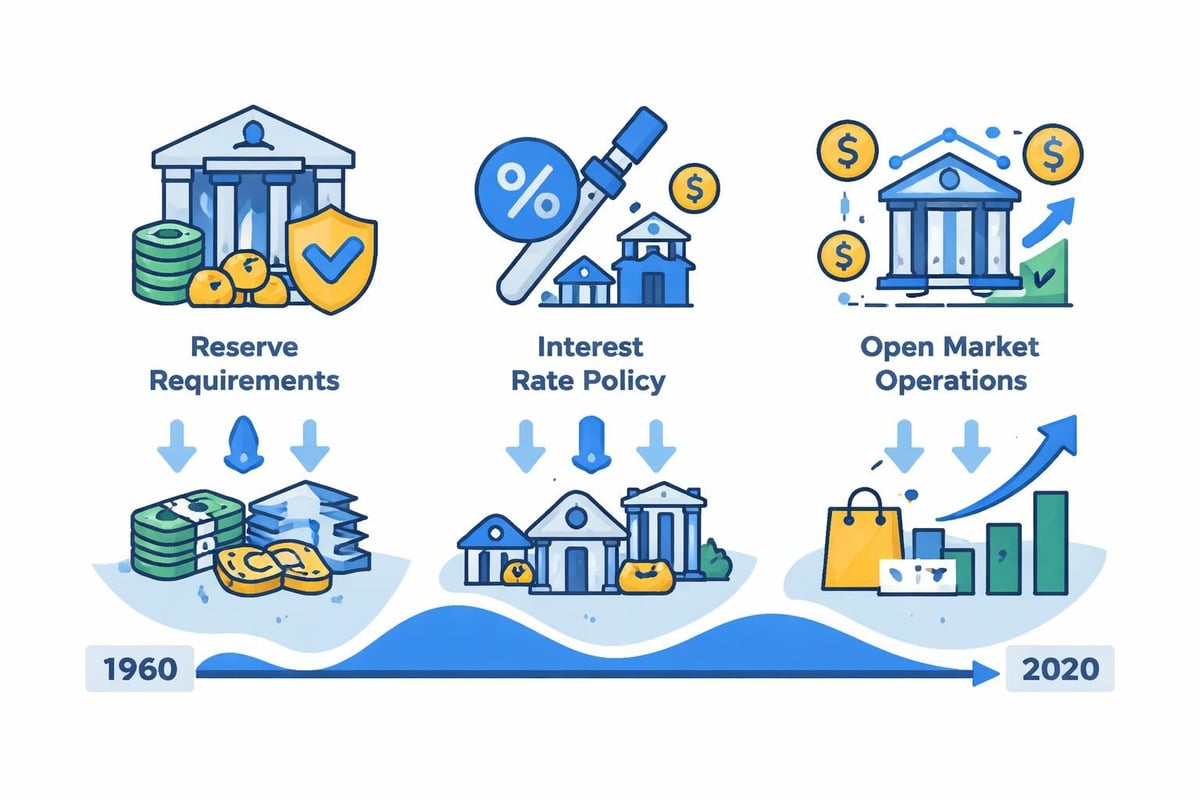
Understanding how reserve requirements function as a monetary policy instrument requires examining their relationship to other central bank tools. Unlike open market operations or interest rate adjustments, changes to reserve requirements affect the banking system's lending capacity directly and immediately.
When a central bank raises the reserve requirement, it essentially freezes additional funds that banks previously could lend. This contractionary action reduces the money supply and can help combat inflation. Conversely, lowering reserve requirements frees up funds for lending, potentially stimulating economic activity during downturns. The relationship between reserve requirements and financial stability has been extensively studied by researchers examining bank risk-taking behaviors.
Reserve requirements influence several critical banking metrics:
- Net interest margin: Lower requirements can improve profitability by increasing lendable funds
- Liquidity ratios: Required reserves contribute to regulatory liquidity measurements
- Capital allocation: Banks must balance reserve requirements with capital adequacy standards
- Lending capacity: The money multiplier determines total potential credit creation
The effectiveness of reserve requirements compared to other policy tools has generated substantial debate among economists. Some argue that reserve requirements represent a blunt instrument that imposes costs on banks without providing central banks with the precision they need for modern monetary management.
The Global Context and International Variations
Different countries have adopted vastly different approaches to reserve requirements, reflecting diverse banking structures, economic conditions, and regulatory philosophies. These international variations provide valuable case studies for understanding the policy's potential and limitations.
China has historically maintained relatively high reserve requirements, sometimes exceeding 20 percent for major banks. Chinese authorities have actively adjusted these ratios as a primary monetary policy tool, raising them to combat inflation and lowering them to stimulate lending. This approach contrasts sharply with many developed economies that have minimized or eliminated reserve requirements entirely.
Lessons from Emerging Markets
Emerging market economies often face different challenges than developed nations when implementing reserve requirements. Higher reserve ratios can help prevent excessive credit growth and currency instability, but they can also constrain financial development and increase borrowing costs for businesses and consumers.
The European Central Bank maintains a 1 percent reserve requirement, significantly lower than historical U.S. levels. European policymakers emphasize that this modest requirement serves primarily as a tool for creating structural liquidity demand rather than as an active policy instrument. Understanding these international differences helps investors and researchers contextualize historical market movements, much like analyzing cash flow statements provides insight into corporate financial health.
The 2020 Policy Shift and Modern Banking
March 2020 marked a watershed moment in American monetary policy when the Federal Reserve reduced reserve requirements to zero percent for all depository institutions. This dramatic change reflected both the immediate pressures of the COVID-19 pandemic and longer-term trends in banking regulation and monetary policy implementation.
The decision to eliminate reserve requirements stemmed from several factors. Modern central banks have developed more sophisticated tools for managing monetary policy, particularly through interest on reserve balances. By paying interest on reserves held at the Federal Reserve, policymakers can influence bank behavior without imposing regulatory minimums.
Additionally, post-2008 financial regulations introduced stricter capital and liquidity requirements that effectively constrained bank lending more than reserve requirements ever did. The Liquidity Coverage Ratio and other Basel III standards created overlapping regulatory obligations that made traditional reserve requirements somewhat redundant.
Implications for Banking Operations
The elimination of reserve requirements fundamentally altered bank balance sheet management. Banks gained greater flexibility in allocating their deposits, potentially improving net interest margins by deploying previously idle funds into earning assets. However, prudent institutions continue maintaining liquidity buffers that often exceed what previous reserve requirements mandated.
Key operational changes include:
- Increased flexibility in managing short-term liquidity needs
- Reduced regulatory compliance costs associated with reserve calculations
- Greater ability to optimize asset-liability management strategies
- Continued voluntary reserve holdings for liquidity and operational purposes
Research examining reserve requirements and economic fluctuations provides theoretical frameworks for understanding how these policy changes might affect long-term economic stability. The shift away from mandated reserves represents an experiment in real-time, with implications that may not become fully apparent for years.
Historical Case Studies and Market Impact
Examining specific historical episodes illuminates how reserve requirement changes have influenced financial markets and economic outcomes. These case studies provide valuable context for investors and analysts seeking to understand the relationship between regulatory policy and market behavior.
The 1936-1937 reserve requirement increases offer perhaps the most cautionary tale. As mentioned earlier, the Federal Reserve's decision to double reserve requirements contributed to a severe economic contraction. Banks responded by hoarding excess reserves rather than expanding lending, defeating the central bank's intention to neutralize potentially inflationary liquidity. This episode influenced monetary policy thinking for decades and contributed to the Federal Reserve's reluctance to use reserve requirements as an active policy tool.

The 1970s Inflation Era
During the high-inflation period of the 1970s, reserve requirements took a back seat to interest rate policy as the Federal Reserve's primary tool. Chairman Paul Volcker's aggressive interest rate increases in the early 1980s demonstrated that traditional monetary policy instruments could achieve results that reserve requirement adjustments could not. This period reinforced the view that reserve requirements served better as a structural feature of the banking system rather than an active policy lever.
The relevance of reserve requirements in economic stabilization has been debated extensively, with researchers comparing their effectiveness to other monetary policy approaches. Historical data suggests that while reserve requirements can influence money supply aggregates, their impact on real economic variables remains complex and sometimes unpredictable.
Reserve Requirements and Banking Crises
Banking crises throughout history have tested the effectiveness of reserve requirements as a stability tool. The Savings and Loan Crisis of the 1980s and 1990s, the 2008 financial crisis, and various emerging market banking failures provide important lessons about the limitations of reserve-based regulations.
During the 2008 financial crisis, reserve requirements played a minimal role in either causing or preventing the collapse. The crisis highlighted that capital adequacy, asset quality, and interconnected risk exposures mattered far more than reserve ratios. Banks failed not because they lacked sufficient reserves against deposits, but because their assets lost value and their capital became impaired.
This realization drove post-crisis regulatory reforms toward comprehensive frameworks addressing capital, liquidity, leverage, and systemic risk. The Dodd-Frank Act and Basel III standards created overlapping safeguards that rendered traditional reserve requirements less central to prudential regulation, similar to how modern corporate finance has evolved beyond simple metrics to encompass complex risk-weighted assets calculations.
Deposit Insurance and Reserve Requirements
The introduction of federal deposit insurance through the FDIC in 1933 fundamentally changed the dynamic between reserves and banking stability. With depositors protected by government guarantees, the panic-prevention function of reserve requirements diminished substantially. Banks still needed adequate liquidity, but the immediate threat of devastating runs decreased significantly.
This relationship demonstrates how different regulatory and institutional features interact to create the overall stability framework. Reserve requirements never operated in isolation but rather as one component of a broader regulatory architecture that included capital standards, supervision, deposit insurance, and lender-of-last-resort facilities.
Contemporary Perspectives and Future Directions
As we examine the current landscape in 2026, the absence of mandatory reserve requirements in the United States represents a significant departure from a century of banking regulation. Other countries continue experimenting with different approaches, providing ongoing natural experiments for researchers and policymakers.
The rise of digital banking, cryptocurrency, and decentralized finance creates new questions about how traditional banking regulations apply. If reserve requirements become obsolete for conventional banks, what analogous safeguards might apply to new financial intermediaries? These questions will shape financial regulation in coming decades.
Central banks worldwide are exploring central bank digital currencies (CBDCs), which could fundamentally reshape the relationship between central banks, commercial banks, and depositors. If individuals and businesses can hold accounts directly with central banks, the entire structure of fractional reserve banking might evolve in unexpected directions. Understanding the historical role of reserve requirements provides essential context for evaluating these emerging possibilities.
Future regulatory considerations include:
- How to maintain systemic liquidity without mandated reserves
- Whether alternative policy tools provide equivalent or superior results
- The role of market discipline versus regulatory requirements
- International coordination as financial systems become increasingly interconnected
- The impact of technological innovation on traditional banking structures
For investors, students, and analysts using platforms like Historic Financial News, understanding reserve requirement history offers valuable insights into how regulatory changes influence market dynamics. The patterns visible in historical data help contextualize current events and anticipate potential future developments.
Practical Applications for Market Analysis
Analyzing historical reserve requirement changes can enhance investment research and economic forecasting. When studying past market movements, identifying concurrent regulatory changes provides important context that pure price data cannot capture.
For example, examining bank stock performance during periods of reserve requirement changes reveals how investors anticipated the policy impacts on profitability and lending capacity. Banks generally benefited from reserve requirement reductions, which freed up capital for lending or investment. Conversely, requirement increases often pressured bank stocks, particularly if the changes came unexpectedly or during periods of tight liquidity.
| Policy Change | Bank Stock Performance | Economic Impact | Duration of Effect |
|---|---|---|---|
| 1936-37 Increases | -15% to -25% | Recession contribution | 12-18 months |
| 1990-92 Reductions | +8% to +12% | Credit availability improvement | 6-12 months |
| 2020 Elimination | +3% to +5% (short-term) | Liquidity enhancement | Ongoing |
Understanding these relationships helps analysts identify similar patterns in other regulatory changes, from capital expenditure tax treatments to accounting standard modifications. The analytical framework applies broadly across financial history.
Reserve requirements have evolved from a critical monetary policy tool to a largely historical artifact in modern American banking, yet their story remains essential for understanding financial regulation and market dynamics. By examining this evolution through platforms like Historic Financial News, investors and researchers can access interactive historical data, AI-powered analysis, and contextual reporting that illuminates the connections between regulatory policy and market movements. This comprehensive historical perspective empowers users to recognize patterns, understand the reasoning behind policy decisions, and develop more informed views about current financial developments.