
Labor Force Participation Rate: A Historical Analysis
The labor force participation rate stands as one of the most revealing indicators of economic health, offering insights that extend far beyond simple employment numbers. This metric captures the percentage of working-age adults either employed or actively seeking work, providing a window into demographic shifts, social changes, and economic pressures that have shaped markets throughout history. For investors and analysts examining historical market patterns, understanding participation trends reveals critical context about past expansions, recessions, and structural transformations in the American economy.
Understanding the Labor Force Participation Rate Fundamentals
The labor force participation rate measures what percentage of the civilian non-institutional population aged 16 and older is either working or actively looking for work. According to Britannica's explanation of labor force participation, this calculation excludes individuals in institutions such as prisons or nursing homes and those serving in the military. The metric provides economists and investors with a more nuanced picture than unemployment rates alone can offer.
Calculation and Methodology
The Bureau of Labor Statistics computes this rate monthly through household surveys. The calculation divides the labor force by the total civilian non-institutional population and multiplies by 100.
Key components include:
- Employed persons holding jobs
- Unemployed persons actively seeking work
- Exclusion of discouraged workers who have stopped looking
- Exclusion of retirees and students not seeking employment
The distinction between unemployment and participation rates becomes crucial for market analysis. A declining unemployment rate might appear positive, but if accompanied by falling participation, it suggests workers are leaving the labor force entirely rather than finding jobs.

Historical Patterns and Secular Trends
Throughout the 20th century, the labor force participation rate underwent dramatic transformations that coincided with major market movements and economic restructuring. The post-World War II period saw relatively stable male participation rates near 87%, while female participation remained below 35% through the 1950s.
The most significant secular trend emerged between 1960 and 2000, when overall participation climbed from 59% to its peak of 67.3% in early 2000. This expansion primarily reflected women entering the workforce in unprecedented numbers, driven by social change, economic necessity, and legislative protections against discrimination.
The Great Decline Since 2000
Trading Economics data reveals that participation began a long descent after 2000, accelerating during the 2008 financial crisis and again during the 2020 pandemic. By 2026, the rate has stabilized but remains substantially below its millennium peak.
| Period | Participation Rate | Primary Drivers |
|---|---|---|
| 1960-2000 | Rising (59% to 67.3%) | Women entering workforce, Baby Boomers maturing |
| 2000-2008 | Gradual decline | Early retirement, educational enrollment |
| 2008-2015 | Sharp decline | Financial crisis, discouraged workers |
| 2020-2026 | Volatile recovery | Pandemic effects, demographic aging |
This decline reflects multiple structural forces: Baby Boomer retirements, increased college enrollment among young adults, disability claims, and discouraged workers exiting during recessions. Each factor carries distinct implications for economic growth potential and market dynamics.
Demographic Breakdown and Diverging Trends
Analyzing participation by demographic segments reveals the complexity beneath aggregate numbers. Gender, age, education, and race all show distinct patterns that have evolved differently over time.
Gender Participation Gaps
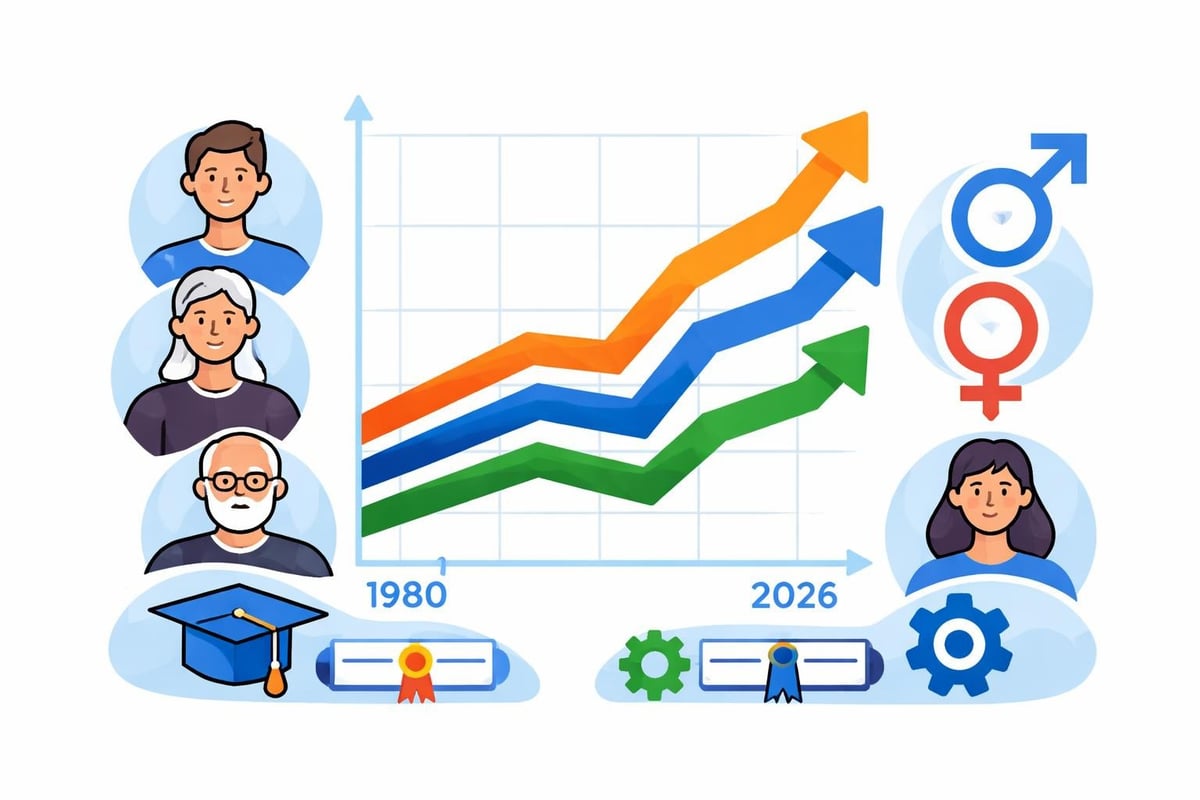
Male participation has declined steadily from 86% in the 1950s to approximately 68% in 2026. Meanwhile, female participation rose from 34% in 1950 to peak at 60% in 1999, before declining to around 57% currently. Recent analysis highlights that women have been exiting the workforce due to childcare challenges and workplace policy gaps, reversing decades of progress.
Key gender dynamics include:
- Declining male participation across all age groups
- Stagnating female participation despite educational gains
- Growing caregiving responsibilities affecting women's workforce attachment
- Policy gaps in paid leave and childcare support
Age-Based Patterns
Younger workers (ages 16-24) show declining participation rates as more pursue higher education. Prime-age workers (25-54) experienced the sharpest declines during the 2008 crisis, with many never returning. Older workers (55+) initially increased participation due to inadequate retirement savings, though this reversed after 2020.
Educational attainment creates stark divisions. Workers with bachelor's degrees maintain participation rates above 70%, while those without high school diplomas participate at rates below 45%. This education gap has widened dramatically since 1980, reflecting the shift toward knowledge-intensive industries.
Economic Implications and Market Correlations
The labor force participation rate directly influences potential GDP growth, inflation dynamics, and monetary policy decisions that drive market movements. When participation declines, the economy's productive capacity shrinks, limiting growth even when demand remains strong.
Lower participation reduces tax revenues while increasing transfer payments for disability and early retirement benefits. This fiscal pressure affects government bond yields and debt-to-equity ratios across the economy. Historical analysis shows that periods of rising participation, like the 1980s and 1990s, coincided with strong equity market performance and productivity gains.
Inflation and Wage Pressure
Tight labor markets with low participation create wage pressure as employers compete for limited workers. This dynamic became evident in 2021-2023 when participation remained depressed while job openings surged. The Federal Reserve closely monitors participation when setting interest rates, recognizing that structural declines require different policy responses than cyclical unemployment.
Market impacts include:
- Reduced growth expectations when participation falls
- Sector rotation toward automation and capital-intensive industries
- Wage inflation affecting operating margins across sectors
- Currency effects as participation gaps emerge between economies
Investors examining historical market cycles must account for participation trends to understand the sustainability of expansions. The 1990s boom benefited enormously from rising participation, while recent expansions faced headwinds from demographic decline.
Cyclical Fluctuations During Recessions
While secular trends shape long-term participation, cyclical movements during recessions reveal important market dynamics. The labor force participation rate typically declines during downturns as discouraged workers stop searching and early retirements accelerate.
The 2008 financial crisis demonstrated this pattern dramatically. Between 2008 and 2010, participation fell 1.5 percentage points, representing millions of workers exiting the labor force. Many never returned, permanently reducing the economy's productive potential. This "scarring effect" has implications for equity valuations and growth forecasts extending years beyond the recession itself.
The 2020 Pandemic Shock
The COVID-19 pandemic produced the sharpest participation decline on record, with the rate falling from 63.4% in February 2020 to 60.2% by April 2020. According to recent labor force data, recovery has been slower than anticipated, particularly among prime-age workers.
| Recession Period | Participation Decline | Recovery Time | Long-term Impact |
|---|---|---|---|
| 1990-1991 | 0.3 points | 12 months | Minimal |
| 2001 | 0.7 points | 24 months | Moderate |
| 2008-2009 | 1.5 points | Never fully recovered | Severe |
| 2020 | 3.2 points | Ongoing as of 2026 | TBD |
Each recession's participation impact correlates with subsequent market performance. The incomplete recovery after 2008 contributed to the prolonged low-interest environment and subdued inflation that characterized the 2010s. Understanding these connections helps investors interpret efficient market hypothesis challenges and identify mispricing opportunities.
International Comparisons and Competitiveness
The U.S. labor force participation rate differs substantially from other developed economies, with implications for relative economic performance and investment returns. Global labor force data shows that many European countries maintain higher participation rates among prime-age workers, particularly women, due to different social policies.
Germany, Sweden, and Canada all show higher female participation rates than the United States, supported by universal childcare and paid parental leave. These policy differences create competitive advantages in labor utilization that affect long-term growth trajectories and currency valuations.
Emerging Market Dynamics
Developing economies often show different participation patterns, with higher overall rates but lower female participation. As these countries develop, they may experience similar female participation surges that powered U.S. growth from 1970 to 2000. Investors tracking emerging markets should monitor these trends as indicators of future growth potential.
The aging demographics affecting developed economies represent a global phenomenon. Japan leads this transition, with participation challenges magnified by restrictive immigration policies. China faces a similar demographic cliff that will test its economic model over coming decades.
Policy Responses and Future Outlook
Government policies significantly influence participation rates through multiple channels. Tax policy, childcare support, retirement incentives, disability programs, and education funding all affect workers' decisions about labor force engagement.
The 2017 tax reform reduced marginal rates, potentially encouraging participation, while expanded disability benefits in previous decades may have reduced it. Research suggests these policy effects accumulate over time, making participation trends difficult to reverse quickly.
Potential Participation Drivers for 2026 and Beyond
Several factors could influence participation in coming years. Baby Boomer retirements will continue exerting downward pressure through the early 2030s. However, inadequate retirement savings may keep older workers employed longer than previous generations.
- Automation reducing demand for certain skill sets
- Remote work expanding geographic labor pools
- Immigration policy affecting workforce growth
- Childcare costs and availability
- Student debt burdens delaying career entry
Recent news indicates that job market dynamics remain complex, with hiring patterns showing sectoral variation and demographic differences. Understanding these nuances requires examining participation alongside traditional employment metrics.

Analyzing Historical Market Events Through Participation Lens
Examining major market events through the labor force participation rate lens provides valuable context that pure price data cannot capture. The 1987 crash occurred during a period of rising participation, suggesting fundamental economic strength that supported quick recovery. In contrast, the 2008 crisis triggered participation declines that signaled deeper structural damage.
The dot-com bubble burst in 2000 coincided with peak participation rates. The subsequent decline in tech employment contributed to broader participation decreases, particularly among younger workers and those without advanced degrees. This context helps explain why recovery from the 2001 recession felt sluggish despite modest GDP growth.
The Inflation Episodes
Historical inflation periods show complex relationships with participation. The 1970s stagflation occurred while female participation was rising rapidly, providing economic offset to productivity challenges. The current inflation episode of 2021-2024 emerged with depressed participation, creating tighter labor markets and stronger wage pressure than demographic trends alone would suggest.
Investors using Historical Financial News to understand market patterns benefit from examining participation data alongside price movements, earnings trends, and monetary policy. This multidimensional approach reveals causal relationships that single-metric analysis misses.
Data Collection and Measurement Challenges
The Bureau of Labor Statistics employs rigorous survey methodology, but the labor force participation rate faces inherent measurement challenges. The Current Population Survey contacts approximately 60,000 households monthly, asking detailed questions about employment status and job search activities.
Measurement complexities include:
- Defining "actively seeking work" versus discouraged workers
- Classifying gig economy and freelance workers
- Accounting for seasonal employment patterns
- Adjusting for population aging and demographic shifts
These methodological questions have policy implications. If discouraged workers were counted as unemployed rather than outside the labor force, unemployment rates would appear much higher. This classification affects everything from political narratives to Federal Reserve decisions and market expectations.
Historical data comparability also presents challenges. Methodology changes in 1994 make long-term comparisons imperfect, though economists have developed adjustment techniques. Investors analyzing century-long trends must account for these data limitations when drawing conclusions about economic patterns.
Regional and Metropolitan Variations
National labor force participation rates mask substantial geographic variation. Rust Belt metropolitan areas show markedly lower participation than Sun Belt regions, reflecting industrial decline, demographic sorting, and regional economic specialization.
Cities like San Francisco and Seattle maintain participation rates above 68%, driven by knowledge-intensive industries and younger populations. Meanwhile, areas heavily dependent on manufacturing or mining show rates below 55%, with many prime-age men exiting the workforce permanently.
These regional disparities correlate with real estate values, municipal finance health, and local equity market performance. Companies headquartered in high-participation regions often show different growth patterns than those in declining areas. Understanding these geographic dimensions adds depth to sector and individual stock analysis.
| Metropolitan Area Type | Participation Rate Range | Primary Factors |
|---|---|---|
| Tech hubs | 66-70% | High education, young workforce |
| Financial centers | 64-68% | Service economy, immigration |
| Manufacturing decline | 54-60% | Job losses, demographic aging |
| Retirement destinations | 52-58% | Retiree concentration |
The Scarring Effect and Long-term Market Implications
Economic research demonstrates that workers who exit during recessions often never return, creating permanent productive capacity loss. This "scarring effect" reduces potential GDP growth, limits tax revenue, and creates persistent fiscal challenges that affect government debt dynamics.
From an investment perspective, scarring implies lower equilibrium interest rates, reduced inflation potential, and changed sector weightings in optimal portfolios. The technology sector benefits from automation demand as participation falls, while consumer discretionary companies face headwinds from reduced household formation and spending.
Historical analysis reveals that participation declines typically precede periods of slower equity market returns. The 2000-2010 period, marked by falling participation, produced near-zero stock returns. Understanding this relationship helps investors calibrate return expectations and adjust portfolio positioning based on demographic trends.
Connecting Participation to Corporate Performance
Corporate earnings and margins show clear sensitivity to labor force participation rates through multiple channels. Tight labor markets with low participation pressure wages upward, compressing margins for labor-intensive industries. Conversely, sectors benefiting from automation and capital intensity may see margin expansion.
Consumer spending patterns shift as participation changes. Higher participation generally correlates with stronger retail sales, housing demand, and credit growth. The participation surge from 1980 to 2000 coincided with robust consumer sector performance and expanding price-to-earnings multiples.
Companies adapting to structural participation declines through automation, outsourcing, or business model changes often outperform peers. Amazon's warehouse automation strategy, for example, positions the company for success regardless of participation trends. Investors identifying these adaptations early gain significant advantages.
Financial institutions face particular sensitivity to participation through credit demand, deposit growth, and loan performance. Lower participation reduces household formation and mortgage demand while potentially increasing default rates as income sources disappear. Banks' net interest margins and loan portfolios reflect these participation dynamics.
The labor force participation rate provides essential context for understanding historical market movements and economic cycles that pure price data cannot reveal. By examining how demographic trends, policy decisions, and cyclical forces have shaped workforce engagement over time, investors gain deeper insight into the fundamental drivers of market performance. Historic Financial News helps you explore these connections through interactive historical data, AI-powered analysis, and comprehensive market context that transforms raw statistics into actionable investment intelligence. Start exploring how labor market patterns have influenced past market cycles to better understand today's investment landscape.