
Economic Growth Guide: Strategies for Success in 2026
Imagine if you could unlock your business or economy’s true potential in 2026, no matter how unpredictable global markets may seem. The path to sustainable economic growth has never been more vital or more challenging.
This guide arms you with practical, data-driven strategies to help you thrive. Discover the fundamentals, explore key drivers and challenges, and gain actionable steps for policymakers, business leaders, and investors.
Ready to outperform global trends? Let’s chart your roadmap for success in the new economic landscape.
Understanding Economic Growth: Foundations and Importance
Economic growth is more than just a statistic; it is the heartbeat of every thriving economy. Understanding its foundations and significance is essential for anyone aiming to navigate 2026’s dynamic landscape. Let us explore what drives economic growth, why it is crucial for the future, its core components, and how to measure progress.

What is Economic Growth?
Economic growth refers to the increase in the market value of goods and services produced by an economy over time. The most common way to measure economic growth is through Gross Domestic Product (GDP), which tracks the total output within a country’s borders. Alternative metrics include Gross National Product (GNP), Gross National Income (GNI), and Purchasing Power Parity (PPP), each offering unique perspectives. It is important to distinguish between nominal growth, which does not account for inflation, and real growth, which does. Since 2020, global GDP per capita has shown steady improvement, highlighting the importance of sustained economic growth.
Why Economic Growth Matters in 2026
Economic growth remains a powerful engine for job creation and rising living standards. In 2026, robust growth will support poverty reduction and enable greater investments in innovation, infrastructure, and social development. This progress aligns with the United Nations Sustainable Development Goal 8, which seeks to promote sustained, inclusive, and sustainable economic growth for all. By driving higher productivity and supporting vital public services, economic growth helps societies build resilience and adapt to changing global conditions. In a world facing uncertainty, prioritizing economic growth is key to unlocking new opportunities and reducing inequalities.
Core Components of Economic Growth
Several factors combine to drive economic growth. Productivity improvements in labor, capital, and technology are crucial, enabling economies to produce more with fewer resources. Factor accumulation, through investments in capital and an expanding labor force, also boosts output. Developing human capital—through education, skills, and health—multiplies the impact of these investments. Entrepreneurship, effective political institutions, and structural change play vital roles in shaping a country’s path to growth. Creating a balanced mix of these components is essential for achieving long-term, sustainable economic growth.
Measuring Success: Key Indicators for 2026
Success in economic growth is measured by a variety of indicators. GDP growth rates remain a primary benchmark, with global averages projected at 1.5 percent in 2025. Employment statistics, labor productivity, and informal employment rates—currently at 58 percent globally—provide insights into labor market health. Other indicators include inequality, resource efficiency, and environmental impact. For a comprehensive outlook on these trends and forecasts for 2026, see the World Bank Global Economic Prospects 2026. Monitoring these metrics helps policymakers and leaders adapt strategies for inclusive and resilient economic growth.
Key Drivers and Challenges for Economic Growth in 2026
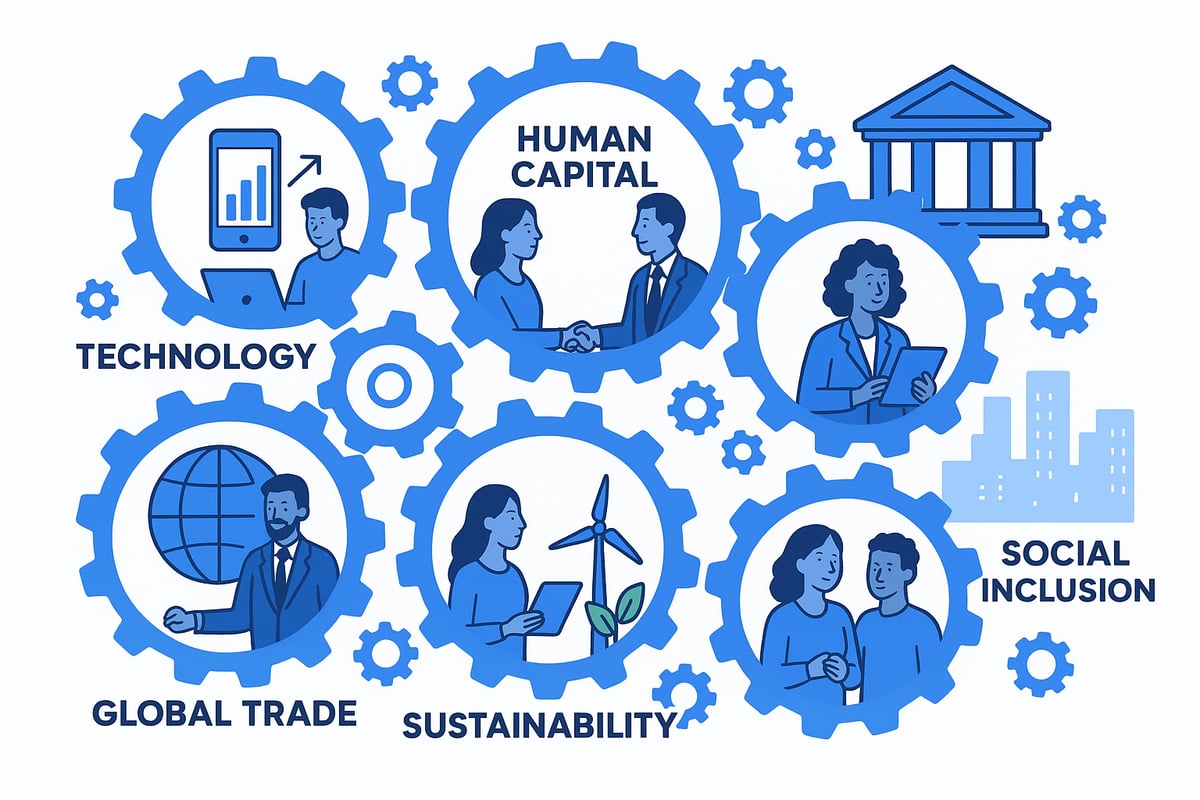
Understanding the key drivers and persistent challenges shaping economic growth in 2026 is essential for policymakers, business leaders, and investors. Each factor contributes uniquely to the opportunities and risks ahead, influencing how economies adapt and thrive amid rapid change.
Productivity, Innovation, and Technology
Productivity gains and technological innovation are at the core of economic growth. In 2024, global labor productivity growth rebounded to 1.5%, reflecting renewed momentum after pandemic disruptions. Digital transformation and investments in automation, artificial intelligence, and advanced manufacturing have diversified economies into high-value, labor-intensive sectors.
However, challenges remain in bridging the digital divide and ensuring equal access to technology. Countries need to upskill their workforce and foster environments conducive to innovation. Without these efforts, productivity improvements may stall, limiting long-term economic growth potential.
Human Capital: Education, Skills, and Health
Human capital is a decisive driver of economic growth. Investments in education, skills development, and health yield higher labor productivity and innovation capacity. In 2024, 259 million youth worldwide were not in education, employment, or training, highlighting a pressing need for targeted interventions.
Addressing gender and age disparities in the labor market is critical. Expanding access to vocational training and lifelong learning can empower more people to participate in and benefit from economic growth. Healthy populations are also more productive, underscoring the importance of robust healthcare systems.
Institutional and Policy Environment
Strong institutions and effective policies underpin sustainable economic growth. Transparent governance, regulatory reforms, and the rule of law foster business confidence and encourage entrepreneurship. Between 2015 and 2023, global compliance with labor rights declined by 7%, signaling the need for renewed policy focus.
Addressing policy uncertainty and trade tensions is vital for stability. According to the OECD Economic Outlook 2025, economies with resilient institutions are better positioned to navigate global shocks and maintain steady economic growth.
Globalization, Trade, and Geopolitical Factors
Globalization continues to shape economic growth through trade, investment, and knowledge exchange. However, rising geopolitical tensions and trade barriers pose significant risks. Recent years have highlighted the importance of resilient supply chains and diversified trade partnerships.
Emerging markets can benefit from global integration, but they must also contend with volatility and shifting power dynamics. Adapting to these realities is essential for sustaining economic growth and seizing new opportunities in the global marketplace.
Environmental Sustainability and Resource Efficiency
Sustainable economic growth in 2026 requires decoupling prosperity from environmental harm. UN SDG 8.4 emphasizes resource efficiency in production and consumption. Green growth strategies, such as investing in renewable energy and promoting circular economy models, are increasingly vital.
Transitioning to a low-carbon economy can drive job creation and competitiveness. Economies that prioritize sustainability are better equipped to manage risks related to climate change, ensuring that economic growth does not come at the expense of future generations.
Persistent Challenges: Inequality and Informal Employment
Despite progress, inequality and informal employment remain significant barriers to inclusive economic growth. Globally, 58% of workers are in informal jobs, with even higher rates in least developed countries and sub-Saharan Africa. These workers often lack social protection and labor rights.
Addressing the gender pay gap, labor market disparities, and expanding social safety nets can unlock greater participation and productivity. Formalizing informal sectors and enforcing labor standards are crucial steps toward achieving equitable economic growth for all.
Proven Strategies for Achieving Economic Growth in 2026
To achieve robust economic growth in 2026, decision-makers need a toolkit of proven, actionable strategies. The following steps provide a comprehensive roadmap for policymakers, business leaders, and investors aiming to outperform global trends and foster lasting prosperity.

Step 1: Foster Innovation and Technological Advancement
Innovation remains a primary driver of economic growth. In 2026, prioritizing research and development, digital transformation, and support for start-ups is essential. Governments and businesses should incentivize R&D investment, create technology hubs, and facilitate knowledge sharing.
A focus on technological upgrading enables economies to diversify into high-value and labor-intensive sectors. To maximize gains, bridging digital divides and upskilling the workforce must be prioritized. For a deeper understanding of how productivity improvements influence economic growth, see Productivity and marginal cost.
Countries with higher innovation indices consistently show stronger GDP growth, underlining the necessity of a dynamic innovation ecosystem.
Step 2: Invest in Human Capital Development
Developing human capital is fundamental for sustainable economic growth. Expanding access to quality education, vocational training, and continuous upskilling ensures that the workforce is prepared for emerging opportunities.
Programs tailored to labor market needs, particularly in STEM and digital skills, help reduce youth unemployment and close skills gaps. Health investments also increase productivity, acting as a multiplier for economic growth.
Countries prioritizing education and training experience lower rates of youth unemployment and are better positioned for future challenges.
Step 3: Promote Inclusive and Decent Employment Opportunities
Inclusive employment policies are vital for balanced economic growth. Strategies should target the reduction of informal employment and labor market inequalities.
Encouraging diversity, gender equality, and youth participation leads to broader labor force engagement. Governments can support these goals through legal protections, wage equity initiatives, and active labor market programs.
Achieving full and productive employment for all, as set by UN SDG 8.5, strengthens social cohesion and long-term prosperity.
Step 4: Strengthen Institutional Frameworks and Governance
Stable, transparent institutions are the backbone of economic growth. Financial system reforms can address rising debt and uncertainty, while robust governance ensures fair competition and reduces corruption.
Enhancing rule of law and regulatory efficiency attracts investment and supports entrepreneurship. Countries with effective institutions enjoy higher long-term growth and resilience during global shocks.
Regular policy review and stakeholder engagement help institutions remain responsive to changing economic landscapes.
Step 5: Accelerate Sustainable and Green Growth
Sustainable growth strategies are crucial for the future of economic growth. Investing in renewable energy, circular economy initiatives, and resource-efficient industries supports both economic and environmental objectives.
Decoupling growth from environmental impact can be achieved through targeted policies and incentives. Leading nations in green technology have demonstrated the potential for simultaneous economic expansion and emissions reduction.
Transitioning to a low-carbon economy unlocks new markets, fosters innovation, and enhances competitiveness.
Step 6: Expand Access to Finance and Infrastructure
Widening access to finance fuels economic growth by empowering micro, small, and medium enterprises (SMEs). Financial inclusion initiatives, such as digital banking and microcredit, help these businesses scale operations and drive job creation.
Modernizing infrastructure in transport, digital connectivity, and energy supply enables efficient production and market access. Strengthening domestic financial institutions, as outlined in UN SDG 8.10, ensures broader participation in economic growth.
Investing in resilient infrastructure supports long-term competitiveness and adaptability.
Step 7: Enhance Global and Regional Collaboration
Collaboration across borders can amplify the benefits of economic growth. Building resilient trade networks and regional partnerships increases market access and resource sharing.
Sharing best practices and harmonizing standards foster mutual learning and economic resilience. Regional trade agreements have proven effective in boosting recovery and stability after economic downturns.
Global cooperation is essential for addressing shared challenges and unlocking new growth opportunities.
Case Studies: Success Stories and Lessons Learned
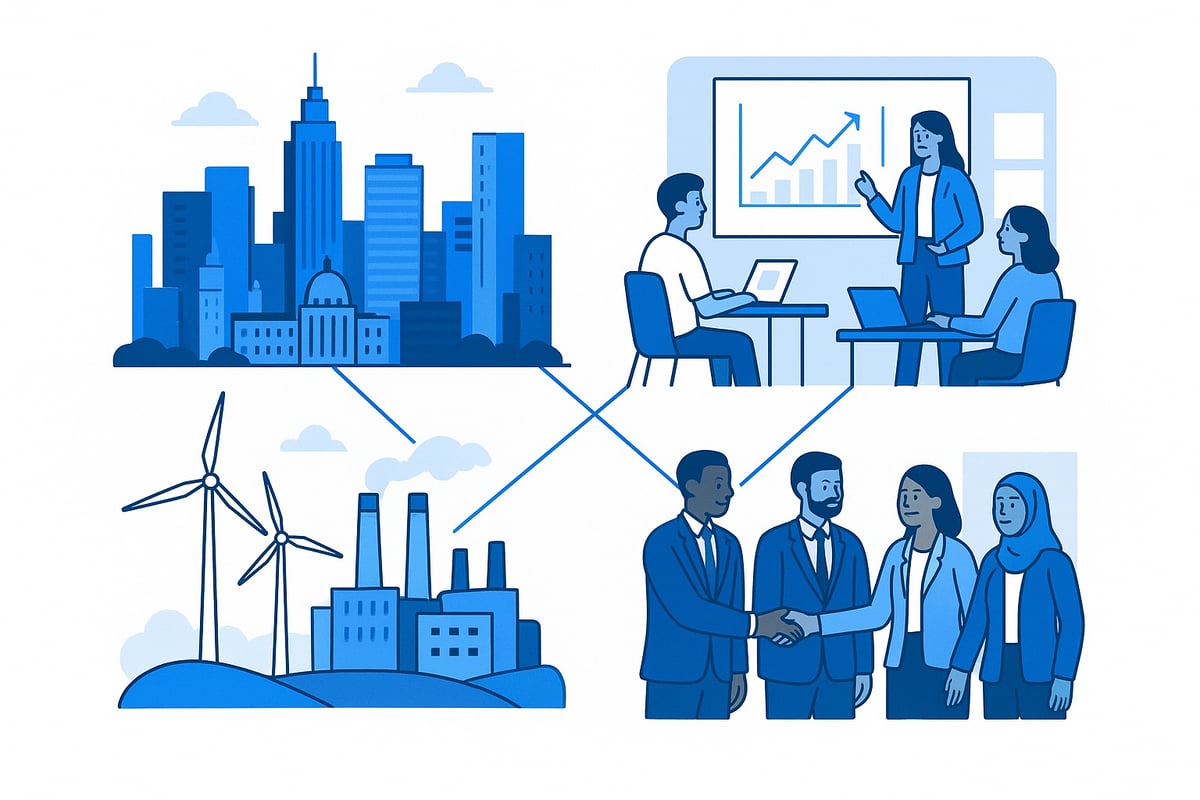
Learning from real-world examples is vital for understanding how economic growth can be achieved and sustained. By examining diverse strategies and outcomes, we uncover practical lessons that guide future policies and investments.
High-Growth Economies in the 2020s
Several countries achieved remarkable economic growth in the 2020s, surpassing 7% annual GDP increases. Common drivers included robust innovation, investments in education, and stable governance. Export diversification also played a central role, particularly in emerging markets. For instance, Southeast Asian economies leveraged technology and trade to climb global rankings.
A closer look at the European Commission Spring 2025 Economic Forecast reveals how policy stability supports moderate yet resilient economic growth in the EU, even amid global uncertainty. These examples underline the power of coordinated strategy and institutional strength.
| Factor | Impact in High-Growth Economies |
|---|---|
| Innovation | Strong GDP gains |
| Education | Workforce competitiveness |
| Governance | Policy continuity |
| Export Diversification | Market resilience |
Overcoming Youth Unemployment: Global Best Practices
Addressing youth unemployment is essential for economic growth. Innovative national programs across East Asia and Europe have significantly reduced the number of young people not in education, employment, or training (NEET). These initiatives often focus on vocational training and apprenticeships that match current market needs.
For example, countries that integrate digital literacy and soft skills into vocational curricula see higher employment rates among youth. Effective public-private partnerships ensure that training aligns with industry demand. This targeted approach empowers the next generation to contribute actively to economic growth.
Green Growth in Action: Sustainable Economic Models
Sustainable economic growth is increasingly linked to environmental responsibility. Nordic nations have excelled in decoupling GDP expansion from carbon emissions, demonstrating that prosperity and sustainability can coexist. By investing in renewable energy and circular economy strategies, these countries create green jobs and boost competitiveness.
Policies that incentivize resource efficiency and low-carbon technologies are key to this transformation. The shift toward green growth not only supports the environment but also opens new avenues for innovation and export. As a result, these models set a benchmark for integrating sustainability into economic growth frameworks.
Inclusive Growth: Addressing Inequality and Informal Work
Inclusive economic growth requires confronting inequality and formalizing informal sectors. Countries making progress on gender and age disparities have implemented policies such as targeted social protection, minimum wage reforms, and expanded labor rights.
Formalization efforts, including streamlined business registration and support for small enterprises, help move workers into secure, productive jobs. Social safety nets further protect vulnerable populations, fostering a more equitable distribution of the benefits of economic growth. These lessons highlight the importance of inclusive strategies for long-term prosperity.
Future Trends and Predictions for Economic Growth in 2026
As 2026 approaches, a range of new trends and emerging challenges will shape the global landscape for economic growth. Understanding these forces is vital for policymakers, business leaders, and investors who wish to stay ahead of the curve.
Digital Transformation and the Future of Work
Digital transformation is set to become a central driver of economic growth in 2026. Automation, artificial intelligence, and remote work technologies are rapidly reshaping how businesses operate and how people engage in the workforce.
Key trends include:
- Widespread adoption of AI tools to boost productivity
- Remote and hybrid work models becoming mainstream
- Increased demand for digital skills and lifelong learning
These shifts bring both opportunities and challenges for economic growth. Companies that invest in upskilling and digital infrastructure will likely outperform their peers, while those that lag behind risk losing competitiveness.
Demographic Shifts and Urbanization
Demographic changes are influencing patterns of economic growth worldwide. In many advanced economies, aging populations are putting pressure on social systems and labor markets. Meanwhile, rapid urbanization continues in emerging markets, driving demand for infrastructure and services.
Consider the following:
- Urban populations are projected to reach 68% of the global total by 2050
- Aging societies may see slower workforce expansion
- Urban planning must prioritize sustainability and inclusivity
Adapting to these trends will be essential for sustaining economic growth. Cities that embrace smart planning and inclusive policies can become engines of innovation and opportunity.
Global Risks: Trade, Geopolitics, and Climate
Persistent global risks threaten the stability of economic growth in 2026. Trade tensions, shifting geopolitical alliances, and climate-related disruptions can hinder progress and create uncertainty for investors.
Major risks include:
- Ongoing trade disputes and supply chain vulnerabilities
- Geopolitical instability in key regions
- Rising incidence of extreme weather events and resource scarcity
Understanding these challenges is crucial. For instance, the specter of stagflation and economic challenges remains a concern, as it can slow growth and complicate policy responses. Proactive risk management and international cooperation will be vital in navigating these headwinds.
Policy and Investment Priorities for the Next Decade
To foster resilient economic growth, strategic policy and investment choices must be made today. Sectors such as green technology, healthcare, and digital infrastructure are poised for expansion, offering new avenues for sustainable development.
Key recommendations include:
- Prioritizing investments in renewable energy and digital connectivity
- Supporting healthcare innovation to address demographic pressures
- Aligning fiscal and monetary policy with long-term growth targets
Expert analysis, such as the SIFMA Economic Advisory Roundtable Survey 2025, highlights the importance of data-driven decisions and adaptive strategies. By focusing on these priorities, stakeholders can help secure robust economic growth through 2026 and beyond.
Action Plan: Roadmap for Policymakers, Businesses, and Investors
A targeted action plan is essential for achieving sustained economic growth in 2026. By focusing on measurable targets, effective policies, resilience, and ongoing improvement, leaders can navigate uncertainty with confidence.
Setting Measurable Growth Targets
Establishing clear, data-driven goals is the first step to unlocking economic growth. Align targets with national priorities and global benchmarks such as the UN Sustainable Development Goals. Use indicators like GDP growth, employment rates, and productivity metrics to set realistic objectives.
Incorporate capital expenditure and investment planning to ensure resources are directed toward high-impact areas. Regularly review and adjust targets as new data emerges. This approach allows for agile responses to changing economic conditions.
Transparent benchmarks keep all stakeholders accountable and focused on outcomes that matter most for economic growth.
Designing Effective Economic Policies
Crafting policies that support economic growth requires a balance of fiscal stimulus, monetary measures, and structural reforms. Consider comprehensive packages that address current challenges, such as supporting small businesses, investing in infrastructure, and fostering innovation.
Successful policy frameworks are grounded in evidence and adapted to local contexts. After the 2020 recession, countries that combined targeted investment with regulatory reform saw faster recoveries. Engage stakeholders from public and private sectors to ensure buy-in and effective implementation.
Continuous policy evaluation ensures that interventions remain relevant and responsive to the evolving economic growth landscape.
Building Resilient and Inclusive Economies
Resilience and inclusivity are central to sustainable economic growth. Strengthen social safety nets to protect vulnerable groups and promote labor rights for all workers. Encourage entrepreneurship and create ecosystems where innovation can thrive.
Promote equitable access to opportunities by removing barriers related to gender, age, or socioeconomic status. Support initiatives that formalize informal sectors and improve job quality. Foster collaboration between business, government, and communities.
A resilient, inclusive approach not only drives economic growth but also builds trust and social cohesion, making economies more adaptable to shocks.
Monitoring, Evaluation, and Continuous Improvement
Robust monitoring and evaluation systems are vital for tracking progress toward economic growth goals. Use key performance indicators (KPIs) to assess policy effectiveness and identify areas for adjustment.
Regular progress reviews foster transparency and enable timely course corrections. Leverage new data and analytics tools to inform decision-making. Encourage a culture of learning, where feedback is used to refine strategies and maximize impact.
By prioritizing continuous improvement, policymakers, businesses, and investors ensure that economic growth remains strong, sustainable, and inclusive in 2026 and beyond.
As you plan your strategy for economic growth in 2026, remember that understanding the past is key to shaping the future. By exploring how markets have evolved and learning from both successes and setbacks, you equip yourself to make smarter, more resilient decisions. That’s exactly what Historic Financial News offers—a unique platform that brings historical context to today’s financial challenges, complete with interactive charts and AI-powered insights. If you want to gain a deeper perspective and help shape this innovative tool, I encourage you to Join Our Beta. Your input could help bring history to life for a new generation of thinkers.