
Earnings Per Share Guide: Understanding EPS in 2025
In 2025, the ability to accurately assess a company’s financial health is crucial for both investors and analysts. One metric stands out in this landscape: earnings per share. This guide will break down what earnings per share means, why it has become a headline figure in today’s market, and how you can use it to make smarter investment choices. We will explain the calculation, types, real-world examples, and common limitations. By the end of this guide, you will be ready to leverage earnings per share for better decision-making and financial analysis in the evolving market environment.
What is Earnings Per Share (EPS)?
Earnings per share is one of the most widely recognized metrics in finance. At its core, earnings per share represents the portion of a company’s net profit that is allocated to each share of common stock. This figure is essential for investors who want to gauge how much profit a company generates for every share they own.
Understanding earnings per share is crucial because it serves as a direct indicator of a company’s profitability. When analysts compare companies within the same industry, they often look to earnings per share as a standard benchmark. It allows for apples-to-apples comparisons and helps clarify which businesses are truly performing well.
You will always find earnings per share prominently displayed in a company’s income statement, typically near the bottom line. Annual reports and quarterly filings also highlight this number, making it easily accessible to shareholders and market observers. If you are new to reading financial statements, resources like EPS Definition and Formula provide further clarity on where to locate and how to interpret this key metric.
A rising earnings per share often signals increasing value for shareholders. When a company grows its earnings per share consistently, it suggests that management is effectively creating wealth for its investors. For example, consider Company X, which reports a net income of $10 million and has 5 million shares outstanding. The calculation looks like this:
| Company | Net Income | Shares Outstanding | Earnings Per Share |
|---|---|---|---|
| Company X | $10,000,000 | 5,000,000 | $2.00 |
Here, earnings per share equals $2.00, meaning each share represents two dollars of profit.
Earnings per share announcements can dramatically influence stock prices. When a company reports earnings per share that exceed analysts’ expectations, its stock price frequently rises. Conversely, a disappointing earnings per share figure can trigger a swift decline. This is because investors closely monitor earnings per share as a proxy for company health and future prospects.
In 2025, several trends are shaping how earnings per share is viewed. Regulatory changes have increased transparency in reporting, and many investors are now paying closer attention to adjusted or ongoing earnings per share figures. According to recent insights from TD and CFI, earnings per share remains among the top three metrics used by both analysts and institutional investors this year.
As financial landscapes evolve, understanding earnings per share helps investors make more informed decisions. By focusing on this metric, you gain a clearer perspective on a company’s profitability and its ability to deliver value over time.

Types of EPS and Their Differences
Understanding the various types of earnings per share is crucial for accurate financial analysis in 2025. Each type provides a unique perspective on a company’s profitability, depending on its financial structure and reporting practices. Let’s break down the main types of earnings per share, highlight their differences, and see how they matter for investors.

Basic EPS vs. Diluted EPS
Basic earnings per share is the simplest form of this metric. It calculates a company’s profit divided by the number of outstanding common shares. This version of earnings per share gives investors a straightforward view of profitability, assuming no future changes in the company’s share count.
Diluted earnings per share goes a step further. It accounts for all possible shares that could be created through convertible securities, such as options, warrants, or convertible bonds. By including these potential shares, diluted earnings per share provides a more conservative and realistic assessment, especially for companies with many stock-based compensation plans.
For example, imagine a tech firm with a net income of $5 million and 2 million common shares. Its basic earnings per share would be $2.50. If employees exercise stock options that could add 500,000 shares, the diluted earnings per share drops to $2.00. This difference is vital for investors who want to understand the impact of potential dilution.
To see detailed calculations and step-by-step examples, you can refer to EPS Calculation Methods Explained. Knowing when to use basic or diluted earnings per share helps investors avoid misjudging a company’s true profitability.
Adjusted EPS, Ongoing EPS, and Other Variations
Not all earnings per share figures are created equal. Companies often report adjusted earnings per share, which excludes one-time items like restructuring costs, legal settlements, or asset sales. This version aims to reflect the company’s core operational performance without the noise of non-recurring events.
Ongoing earnings per share is another important variation. It strips away temporary gains or losses, presenting a clearer picture of sustainable profitability. Analysts and investors frequently rely on adjusted or ongoing earnings per share to compare companies across periods or industries.
Consider a manufacturing company that sells a major asset, resulting in a one-off profit. Its standard earnings per share might spike for that quarter, but the adjusted earnings per share would show a more realistic, lower figure after removing the asset sale. This approach helps investors focus on the earnings power that is likely to persist.
Financial analysts often discuss adjusted earnings per share during earnings calls, as it allows for apples-to-apples comparisons. Understanding these variations in earnings per share can help you look beyond headline numbers and gain real insight into a company’s health.
EPS in Different Sectors and Regions
The interpretation of earnings per share can differ significantly by industry and geographic region. For example, banks and financial institutions often report higher or more stable earnings per share than fast-growing tech companies, reflecting distinct business models and capital needs.
Regional accounting standards also influence how earnings per share is reported. Companies in North America typically follow U.S. GAAP rules, while European firms use IFRS. These standards can lead to differences in how net income and share counts are calculated, affecting the final earnings per share figure.
A North American bank might report earnings per share based on a strict definition of net income, while a European tech firm could adjust for various items under IFRS. Sector-specific benchmarks are common in 2025, with investors comparing earnings per share against industry peers to gauge performance.
Ultimately, understanding the context of sector and region ensures you interpret earnings per share figures accurately. This awareness helps you avoid misjudgments and make better-informed investment decisions.
How to Calculate Earnings Per Share: Step-by-Step Guide
Understanding how to calculate earnings per share is essential for investors and analysts in 2025. The process may seem technical at first, but breaking it down into clear steps makes it manageable. Follow this guide to confidently determine a company's earnings per share, using the latest best practices and tools.
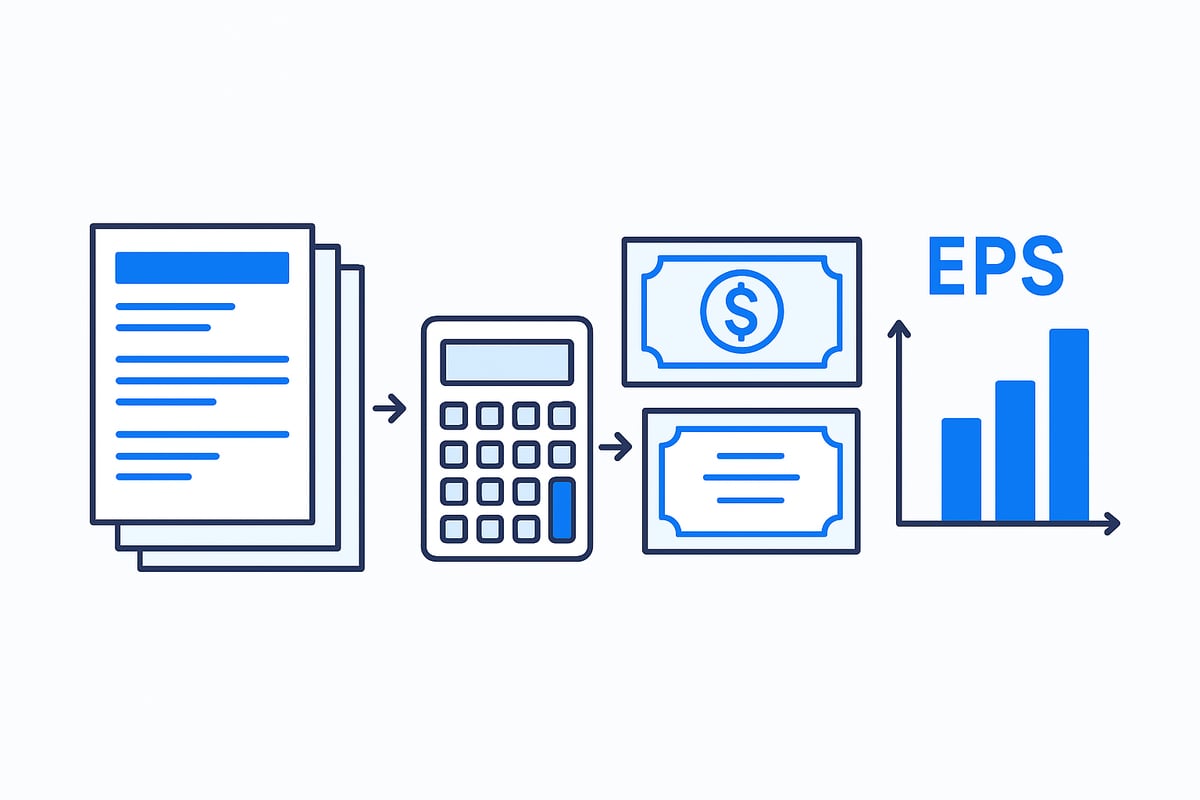
Step 1: Gather Required Financial Data
To start calculating earnings per share, you first need three core pieces of information. Locate the company’s net income, which is typically found at the bottom of the income statement. Next, check if there are any preferred dividends, since these payments must be subtracted from net income. Lastly, determine the weighted average number of shares outstanding during the period, not just the year-end figure.
For example, if a company reported $8 million in net income, paid $500,000 in preferred dividends, and had 3 million weighted average shares, you have the basic data needed. For a deeper look at where to find these figures, see understanding income statements.
Accurate data ensures your earnings per share calculation is reliable and consistent.
Step 2: Apply the EPS Formula
With your data ready, apply the earnings per share formula:
Earnings Per Share = (Net Income – Preferred Dividends) / Weighted Average Shares Outstanding
Each component plays a key role. Net income shows the profit available, preferred dividends are obligations to certain shareholders, and the share count spreads the profit across all common stock. For instance, using the earlier numbers: ($8,000,000 – $500,000) / 3,000,000 = $2.50 earnings per share.
This formula is standard and forms the foundation for all further EPS analysis.
Step 3: Adjust for Dilution (If Needed)
Some companies have convertible securities, like stock options or convertible bonds, that could increase the number of shares if exercised. To calculate diluted earnings per share, identify all securities that could convert into common shares. Then, add these potential shares to the weighted average shares outstanding.
Suppose a tech firm has 300,000 employee stock options that could be exercised. The diluted share count would then be 3,300,000, lowering diluted earnings per share to about $2.27. This adjustment gives a more conservative view of profitability, especially for companies with many convertible instruments.
Always review the notes in financial statements for details on potential dilution.
Step 4: Consider Adjustments for Non-Recurring Items
Earnings per share can be skewed by large, one-time events like asset sales or legal settlements. Analysts often calculate adjusted earnings per share by removing these extraordinary items to better reflect ongoing performance.
For example, if a company’s net income includes a $1 million gain from selling property, subtract this from net income before calculating adjusted earnings per share. This approach helps you see the company’s true earning power from its core business.
Adjusted earnings per share is particularly important when comparing companies or evaluating long-term trends.
Step 5: Interpret the Result
Once you have calculated earnings per share, it’s time to interpret the number. Compare current EPS with previous periods to spot trends. Benchmark the figure against industry peers to understand relative performance.
Consider the company’s overall financial health, not just the earnings per share figure. For example, a rising EPS may signal growth, but always check if it aligns with revenue and cash flow trends.
A single earnings per share number is most powerful when viewed in context with broader financial data.
Common Challenges and Pitfalls in EPS Calculation
Calculating earnings per share can have pitfalls. One common mistake is using the end-of-period share count instead of the weighted average. Share buybacks or new issuances during the year can significantly alter the denominator.
Another challenge is forgetting to subtract preferred dividends, which overstates EPS for common shareholders. Companies may also adjust the share count for mid-year stock issuances, leading to errors if not tracked closely.
| Pitfall | How to Avoid |
|---|---|
| Wrong share count | Use weighted average |
| Ignoring buybacks or issuances | Track all share changes |
| Missing preferred dividends | Always subtract from net income |
Careful attention to these details ensures your earnings per share calculations remain accurate.
EPS Calculation Tools and Resources
Today, several tools simplify the earnings per share calculation. Online calculators and spreadsheet templates are widely available, making it easier to input the required data and get quick results.
Popular platforms like Yahoo Finance and CFI offer EPS calculators, and many financial news sites provide templates. Always cross-check your results with official company filings to ensure accuracy.
For large data sets, spreadsheet formulas can automate earnings per share tracking over time. These resources help both new and experienced investors streamline their analysis.
Interpreting EPS: What Investors Should Know in 2025
Earnings per share remains one of the most closely watched metrics for investors in 2025. When a company reports strong growth in earnings per share, it often signals underlying profitability and can attract significant attention from the market. For many, a rising earnings per share is seen as a green light for investment, reflecting both operational success and potential for future returns.
Yet, earnings per share does not exist in isolation. It plays a central role in valuation, particularly when paired with the price-to-earnings ratio explained. This ratio is a staple of equity analysis, helping investors compare the price they pay for a stock to the company’s profitability. A high earnings per share with a low price-to-earnings ratio can indicate an undervalued opportunity, while the opposite may be a warning sign.
Trends matter just as much as absolute figures. Investors should not make decisions based on a single quarter’s earnings per share. Instead, look for consistent growth or patterns over time. For example, a company whose earnings per share remains flat while its share price rises could be experiencing market speculation or benefiting from broader sector momentum, rather than true earnings improvement.
It is also critical to recognize the limitations of earnings per share. This metric can be influenced by accounting choices, non-recurring items, or share buybacks. In fact, recent data suggests that more than 60 percent of S&P 500 companies highlight earnings per share in their earnings releases, but not all growth is created equal. Share buybacks, for instance, can boost earnings per share even if net income does not improve, potentially giving a misleading picture of performance.
In 2025, interpreting earnings per share requires greater context. Economic factors like inflation, changing interest rates, and evolving business cycles all impact profitability and, by extension, earnings per share. Investors should combine earnings per share analysis with other financial metrics and take a holistic view, ensuring decisions are grounded in both the numbers and the broader economic landscape.

Limitations and Criticisms of EPS
Understanding the limitations of earnings per share is essential for investors who want to make informed decisions. While EPS is widely used, it is not a perfect measure of a company's financial health or true profitability. Several factors can distort the figure and lead to misinterpretation if not carefully considered.
EPS and Capital Structure Limitations
One of the most significant criticisms of earnings per share is its disregard for a company’s capital structure. EPS focuses on net income divided by common shares, but it ignores how much debt or preferred stock a company uses to generate those profits.
For example, two businesses with identical earnings per share could have very different risk profiles if one is heavily leveraged and the other is not. This can mask underlying risks and give a misleading impression of financial strength.
Impact of Non-Cash Items and Accounting Policies
Earnings per share can also be skewed by non-cash expenses, such as depreciation and amortization. These items reduce reported net income without affecting actual cash flow, which may distort the real earnings power of a business.
Additionally, differences in accounting policies—such as revenue recognition and expense timing—can create inconsistencies across companies or time periods. This makes it challenging to compare earnings per share figures without digging into the details.
| Factor | EPS Impact |
|---|---|
| Depreciation | Lowers EPS |
| Amortization | Lowers EPS |
| Aggressive Revenue | Raises EPS |
| Delayed Expense | Raises EPS |
One-Time Events and Share Buybacks
Earnings per share is often influenced by one-time events like asset sales, restructuring charges, or legal settlements. These items can cause EPS to spike or drop in ways that do not reflect the company's ongoing performance.
Share buybacks are another factor that can artificially boost earnings per share. For instance, a company may repurchase shares, reducing the denominator and increasing EPS, even if net income is flat or declining. According to TD, 40% of EPS beats in 2024 were due to buybacks, not true profit growth. In some cases, a company with falling net income may still report higher EPS because of aggressive buybacks.
Analyst Perspective and Best Practices
Given these limitations, analysts recommend using earnings per share alongside other financial metrics, such as return on equity and cash flow. Relying solely on EPS can lead to poor investment decisions, especially when companies use accounting maneuvers or financial engineering to enhance the number.
For a deeper dive into proper EPS analysis and reporting standards, consult the Comprehensive EPS Reporting Guide. Combining EPS with broader context ensures a more accurate view of company performance.
EPS Trends and Best Practices for Investors in 2025
The landscape for evaluating earnings per share in 2025 is evolving rapidly. Investors must keep pace with changes in reporting standards, sector-specific benchmarks, and market expectations to make informed decisions. Understanding these trends and employing best practices can give you an edge in interpreting financial performance.
EPS Trends to Watch in 2025
One of the most significant trends for earnings per share in 2025 is the heightened focus on adjusted and diluted EPS. Financial statements now emphasize transparency, with companies providing more detailed reconciliations and breakdowns. This shift reflects new regulatory requirements designed to help investors see past one-time gains or losses.
The tech sector, in particular, has seen diluted EPS become more prominent, largely due to widespread stock-based compensation. As more employees receive options and restricted stock, the number of potential shares increases, making diluted EPS a more conservative measure of profitability.
Environmental, Social, and Governance (ESG) factors are also shaping how earnings per share is reported. Companies are increasingly disclosing how sustainability initiatives impact their financial results. For example, investments in green technology or compliance expenses may affect core earnings.
Regulators have also updated EPS disclosure rules in 2025, requiring clearer explanations of adjustments and non-GAAP measures. For a long-term perspective, historical analysis is invaluable. According to S&P 500 EPS Trends 1970–2025, analysts can see how earnings per share has trended across decades, helping to contextualize current results.
Best Practices for Using EPS in Investment Decisions
To get the most out of earnings per share analysis, investors should always combine EPS with other financial ratios such as P/E, ROE, and EBITDA. This holistic approach helps to avoid overreliance on a single figure and reveals deeper insights into profitability and valuation.
Consistent trend analysis is essential. Review earnings per share over multiple years, not just one quarter, to spot patterns and cyclical changes. Adjust your analysis for the company’s sector. For instance, banks and tech firms have different capital structures and typical EPS ranges, so direct comparisons may be misleading.
Factor in the company’s stage of growth. Mature companies may show steady EPS, while high-growth firms might have more volatility due to reinvestment and expansion. Always use earnings per share as one part of a broader due diligence process, incorporating management commentary, industry outlooks, and macroeconomic factors.
Finally, avoid making snap decisions based on single-quarter surprises. Short-term fluctuations in earnings per share can result from temporary events, which may not reflect the company’s underlying health.
Real-World Case Studies and Examples
Examining real-world examples can clarify how earnings per share is used in practice. Consider Company A, which consistently grows its EPS year after year. This reliable growth often attracts investors and correlates with strong share price performance, as it signals operational efficiency and sound management.
In contrast, Company B experiences volatile earnings per share due to frequent non-recurring items, such as asset sales or restructuring charges. While headline EPS may spike, underlying profitability remains unpredictable. Investors who look only at the reported number without understanding the context risk making poor decisions.
Sector benchmarks also play a vital role. For example, tech firms generally have lower initial EPS but higher growth potential, while banks might have stable but modest earnings per share. Comparing companies within their sector helps avoid faulty conclusions based on inappropriate benchmarks.
These cases highlight the importance of context. Always dig deeper into what drives EPS changes before making investment choices.
Avoiding Common EPS Misinterpretations
Misinterpreting earnings per share is a common pitfall for new and experienced investors alike. One major error is relying solely on EPS for valuation, ignoring other factors such as cash flow, debt levels, or revenue growth.
Watch for red flags, including sudden spikes in earnings per share or aggressive accounting adjustments. These could result from share buybacks or one-time events rather than true operational improvements.
Always consult the notes and Management Discussion and Analysis (MD&A) sections in financial reports for critical context. For example, analysts sometimes downgrade companies after discovering that EPS gains were driven by accounting changes rather than real profit growth.
By maintaining a critical eye and using earnings per share alongside other data, you can avoid costly mistakes and make smarter investment decisions in 2025.
Frequently Asked Questions About EPS
Navigating the world of earnings per share can pose many questions for investors in 2025. Here, we address the most common FAQs to help you use this crucial metric confidently in your financial analysis and investment decisions.
What is the difference between basic and diluted EPS?
Basic earnings per share is calculated using only the company’s outstanding common shares. Diluted EPS, on the other hand, factors in potential shares that could be created from convertible securities, such as stock options or convertible bonds. This adjustment provides a more conservative view of profitability, especially for companies with complex capital structures. For a detailed explanation, see convertible bonds and diluted EPS.
How do share buybacks affect EPS?
When a company repurchases its own shares, the number of outstanding shares decreases. This reduction often leads to a higher earnings per share, even if net income remains unchanged. While this can make financial results appear stronger, it is important to look beyond the headline number and consider whether real profit growth is driving the change.
Why do some companies report adjusted EPS?
Adjusted earnings per share excludes one-time items, such as restructuring costs or asset sales, to show a clearer picture of ongoing operational performance. Analysts and investors frequently rely on adjusted EPS to compare results across periods and companies, as it helps filter out temporary or non-core events.
How often is EPS reported?
Most public companies disclose earnings per share on a quarterly basis as part of their earnings releases. In addition, annual EPS figures are included in yearly reports. This regular reporting helps investors track trends and make informed decisions based on recent performance.
What are the limitations of using EPS for investment decisions?
While earnings per share is a valuable profitability metric, it has limitations. EPS can be influenced by accounting choices, share buybacks, or non-recurring items. It does not account for differences in capital structure or cash flow, so it should be used alongside other financial ratios for a comprehensive analysis.
Can EPS be negative, and what does that mean?
Yes, earnings per share can be negative if a company reports a net loss for the period. Negative EPS signals that the company is not currently profitable. Persistent negative EPS may raise concerns about long-term viability or indicate that the business is in a turnaround phase.
How does EPS relate to dividends and shareholder value?
EPS plays a key role in determining a company’s ability to pay dividends and create long-term value for shareholders. Higher or steadily growing earnings per share often support increased dividend payouts, which can enhance shareholder value and EPS over time.
What are common mistakes when calculating or interpreting EPS?
Investors sometimes confuse weighted average shares with end-of-period shares, overlook preferred dividends, or misinterpret the impact of share buybacks. Additionally, failing to adjust for non-recurring items can distort the true earnings per share picture.
How do accounting standards (GAAP vs. IFRS) impact EPS?
Earnings per share calculations can vary depending on whether a company follows GAAP (U.S.) or IFRS (International) accounting rules. Differences in revenue recognition, expense timing, and treatment of certain securities may affect reported EPS, so always consider the accounting context.
Where can I find reliable EPS data for companies?
Reliable earnings per share data is available on financial news platforms, company filings, and investment research sites. Popular sources include Yahoo Finance, company annual reports, and data providers like CFI and TD, which offer up-to-date and historical EPS figures.
Quick Reference Table: EPS Reporting Basics
| Question | Typical Answer |
|---|---|
| EPS Reporting Frequency | Quarterly, Annually |
| Adjusted EPS Usage | Excludes non-recurring items |
| Common Data Sources | Yahoo Finance, Company Reports, CFI, TD |
| Negative EPS Meaning | Company reported a net loss |
For new investors, remember to use earnings per share together with other metrics, analyze multi-year trends, and review footnotes or management commentary for context. This approach will help you make more informed portfolio decisions in 2025.
Now that you have a clear understanding of how to interpret EPS in today’s dynamic financial world, you’re better equipped to make informed investment decisions and spot trends that matter. If you’re eager to go deeper and see how historical events have shaped the financial markets, we invite you to explore our new platform. By joining as a beta user, you’ll get early access to interactive charts, AI-powered insights, and unique stories that bring context to every market move. Ready to look beyond the numbers and learn from the past?
Join as a Beta User