
Discount Rate Guide 2025: Strategies, Insights, and Best Practices
As we approach 2025, the discount rate stands at the heart of every major financial decision. Navigating today’s volatile markets, with persistent inflation and rapidly changing central bank policies, makes setting the right discount rate more challenging than ever.
For finance professionals and investors, mastering discount rate strategies is not just academic—it is essential for accurate investment valuation, project feasibility, and corporate finance choices. The ability to select and apply the right rate directly shapes business outcomes.
This guide is your comprehensive resource for the year ahead. We will cover discount rate fundamentals, determination methods, the latest market trends, step-by-step strategies, and best practices for 2025.
Here’s what you can expect:
- Clear definitions and key concepts
- Types of discount rates and their applications
- Proven calculation methods
- Market and regulatory insights
- Actionable strategies and expert recommendations
Prepare to elevate your financial analysis and decision-making in 2025.
Understanding Discount Rates: Foundations and Key Concepts
Discount rates are at the heart of nearly every major financial decision. They shape how organizations evaluate investments, price risk, and compare present and future cash flows. Mastering the discount rate is essential, as it connects today's economic choices to tomorrow's financial outcomes.

What is a Discount Rate?
A discount rate is the interest rate used to determine the present value of future cash flows. In other words, it reflects how much less a sum of money received in the future is worth compared to the same amount today.
The discount rate is fundamental in finance because it quantifies the time value of money and incorporates risk. Even a small shift in the discount rate can lead to a significant change in how investments are valued. For example, if you expect to receive $1,000 five years from now, the present value will vary greatly depending on the rate applied.
This rate bridges the gap between today's capital and tomorrow's returns. To understand the mechanics behind this, see this detailed explanation of present value and time value concepts.
Types of Discount Rates
There are several types of discount rate, each serving different purposes. Common examples include the risk-free rate, required rate of return, cost of capital, and weighted average cost of capital (WACC).
Discount rates can be nominal, which include expected inflation, or real, which strip inflation out. Sector-specific rates are also used, for instance, real estate projects may have a different discount rate than private equity deals.
Consider this comparison:
| Type | Example Use | Typical Value |
|---|---|---|
| Risk-Free Rate | Government bonds | 3% |
| WACC (Tech Firm) | Tech investments | 8-10% |
| WACC (Utility Company) | Utility projects | 5-7% |
The right discount rate always depends on the context and the purpose of the analysis.
Why Discount Rates Matter in 2025
The discount rate is more critical than ever in 2025 due to heightened market volatility and evolving regulatory standards. Accurate discount rate selection influences investment appraisal, business valuation, and capital budgeting outcomes.
Regulators and auditors are placing increased scrutiny on how companies determine and disclose their discount rates. For instance, a discounted cash flow (DCF) model used in a major merger may yield dramatically different valuations if the discount rate shifts by even a fraction of a percent.
Given the macroeconomic uncertainty forecasted for 2025, choosing the right discount rate has never been more consequential for sound financial decisions.
Common Misconceptions and Pitfalls
Many analysts mistakenly use arbitrary discount rates or fail to adjust for changing inflation and risk factors. Anchoring to outdated rates can result in flawed investment appraisals.
A common pitfall is ignoring inflation, especially in high-volatility environments. For example, a project valued using an inappropriate discount rate may appear profitable when, in reality, it destroys value once proper adjustments are made.
To avoid such errors, ensure your discount rate is context-driven, regularly reviewed, and based on current market and economic data.
Calculating Discount Rates: Methods, Formulas, and Real-World Application
Discount rate calculation sits at the heart of every robust financial analysis. Whether you are evaluating investments, valuing companies, or assessing project feasibility, the method you use to determine the discount rate can make a significant difference in outcomes. Understanding calculation techniques and their real-world application is crucial for finance professionals aiming to stay competitive in 2025.
Core Calculation Methods
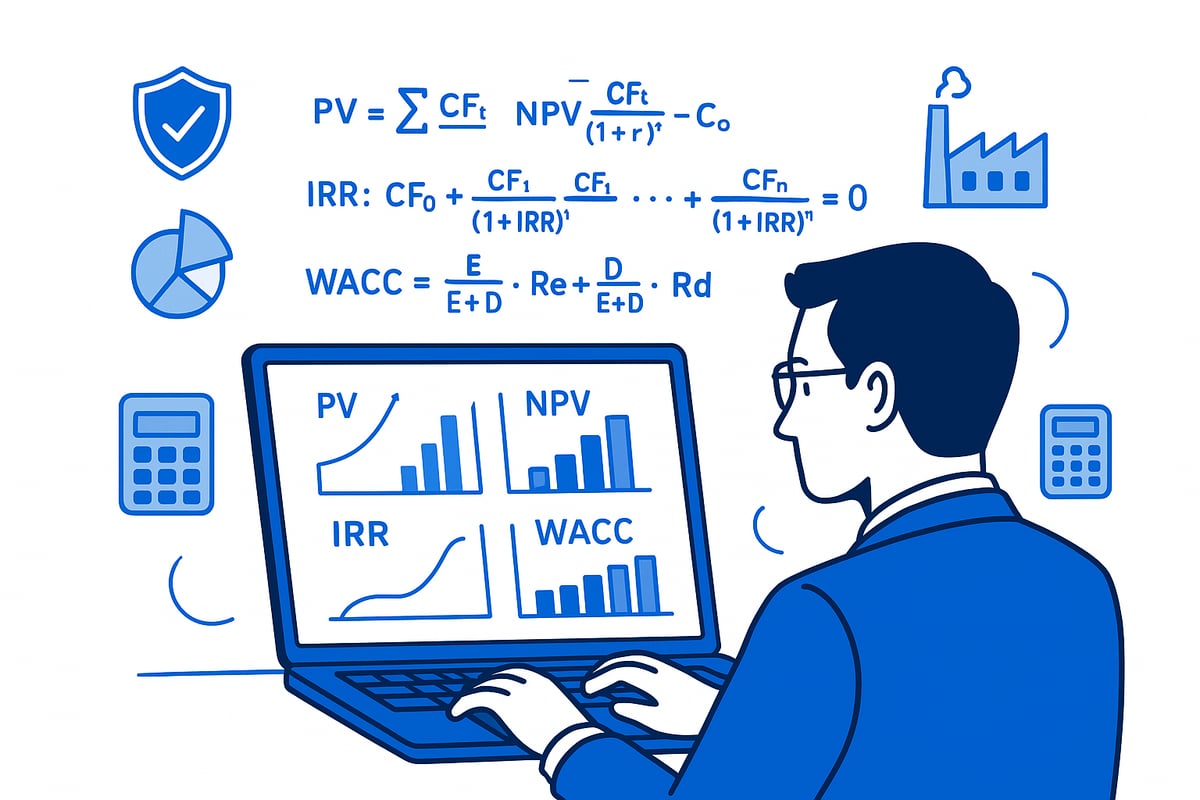
The discount rate is most often applied through key formulas like Present Value (PV), Net Present Value (NPV), and Internal Rate of Return (IRR). Each method provides a structured way to translate future cash flows into today’s terms, factoring in the time value of money.
Common formulas include:
- PV:
PV = FV / (1 + r)^n - NPV:
NPV = Σ [CF_t / (1 + r)^t] - Initial Investment - IRR: The rate that sets NPV to zero
For example, consider a project with a $10,000 inflow in three years and a 7% discount rate. The present value would be 10,000 / (1 + 0.07)^3 ≈ $8,163. Even a small change in the discount rate can shift this value significantly, underlining the method’s importance in decision-making.
Weighted Average Cost of Capital (WACC)
The weighted average cost of capital is a widely used discount rate in corporate finance. WACC blends the cost of equity and the after-tax cost of debt, weighted by their proportions in the company’s capital structure.
WACC formula:
WACC = (E/V) * Re + (D/V) * Rd * (1 - Tc)
Where:
E = Market value of equity
D = Market value of debt
V = E + D
Re = Cost of equity
Rd = Cost of debt
Tc = Corporate tax rate
For instance, a tech company with 70% equity and 30% debt, equity cost at 8%, and debt at 4% (tax rate 25%) would have a WACC of about 6.5%. Industry benchmarks show WACC tends to be higher for tech firms than utilities. For further details on WACC’s components and calculation, see What is weighted average cost of capital.
Adjusting for Risk: Risk Premiums and Industry Factors
A crucial part of discount rate selection is adjusting for risk. This means adding risk premiums to the base rate to reflect project-specific, industry, or country risks.
For example, investing in an emerging market may require a country risk premium added to the base discount rate, while a startup in a volatile sector might need a higher industry premium. Sector benchmarks, often published annually, help guide these adjustments. Using these risk premiums ensures the discount rate accurately reflects the uncertainty and context of each investment.
Practical Tools and Calculators
Today’s finance professionals have access to a range of tools for calculating the discount rate, from online calculators to sophisticated Excel templates. Automated tools streamline the process, allowing quick scenario analysis and sensitivity testing.
Popular resources include Wall Street Prep’s discount rate calculator and downloadable Excel models. While these tools can save time, it is essential to input realistic assumptions and understand the underlying methodology, as automated outputs only add value when guided by expert judgment.
Real-World Application Scenarios
Applying the discount rate in real-world situations reveals its practical impact. In mergers and acquisitions, infrastructure projects, or startup investments, the chosen calculation method can yield widely varying valuations.
For example, running a sensitivity analysis on a discounted cash flow model shows how a 1% increase in the discount rate can decrease project NPV by thousands or even millions. Surveys from 2024 indicate most CFOs rely on NPV and WACC, but adapt their approach based on deal type and sector.
Discount Rate Trends and Market Insights for 2025
As we approach 2025, understanding discount rate trends is crucial for making informed financial decisions. The evolving economic environment, regulatory shifts, and global factors are shaping how professionals set and apply discount rates. This section explores the most important trends and insights, giving you the knowledge to navigate the year ahead with confidence.
Macroeconomic Influences on Discount Rates
Macroeconomic factors are set to play a pivotal role in shaping discount rate levels during 2025. Central banks, especially the Federal Reserve, are expected to adjust their policies in response to inflation and economic growth trends. According to Goldman Sachs expects Fed to deliver three rate cuts in 2025, anticipated reductions in the policy rate could lower the risk-free rate, a key component of the discount rate. Historically, rising inflation increases discount rates, while stable economic growth can help moderate them. The interplay of these forces will affect investment decisions and valuations across all sectors.
Sector-Specific Discount Rate Shifts
The discount rate landscape is not uniform across industries. In 2025, sectors like real estate and energy are experiencing higher discount rates due to elevated borrowing costs and regulatory changes. Technology companies, on the other hand, may benefit from lower rates thanks to strong growth prospects and investor appetite for innovation. Industry benchmarks from sources such as the Corporate Finance Institute reveal that average discount rates differ widely, reflecting sector-specific risks and capital structures. For example, utilities tend to have lower discount rates than startups, as their cash flows are more predictable and less risky.
Regulatory and Accounting Updates
Regulatory bodies and accounting standard setters are increasing their scrutiny of discount rate assumptions. New guidelines under IFRS and FASB are pushing firms to justify their discount rate choices with transparent, data-backed methodologies. Auditors are focusing on whether selected rates align with market realities and company-specific risks. Recent audit findings have highlighted cases where the use of an inappropriate discount rate led to significant misstatements in asset valuations. As a result, organizations are dedicating more resources to documentation and compliance, making the discount rate a central topic in 2025 financial reporting.
Global Perspectives: Regional Variations in Discount Rates
Discount rate trends vary significantly around the globe. In North America and Western Europe, relatively stable economic conditions support moderate discount rates. In contrast, emerging markets in Latin America and Asia-Pacific often require higher discount rates to account for increased country risk and currency volatility. For example, a project in Brazil may include a country risk premium that pushes the discount rate well above that used for a similar project in Germany. Cross-border surveys reveal that regional differences in inflation, monetary policy, and sovereign risk remain key drivers of these variations.
Behavioral and Psychological Factors
Human behavior influences discount rate selection more than most realize. Cognitive biases, like optimism bias and recency effect, can cause decision-makers to underestimate risk, leading to lower discount rates than warranted. For instance, overly positive growth projections may result in under-discounting future cash flows, skewing investment appraisals. Recognizing these biases is essential for setting realistic discount rates. Firms are increasingly training teams to spot and adjust for psychological pitfalls, improving the reliability of their financial models and forecasts.
Data-Driven Insights: Statistics and Forecasts
Recent data offers valuable insights into discount rate trends for 2025. Industry reports from CFI and Wall Street Prep show that average discount rates by sector have shifted in response to changing macroeconomic conditions. For example, the median discount rate for U.S. real estate rose from 7.2% in 2023 to 8.1% in early 2025, while technology sector rates remained steady near 9.5%. The table below summarizes these shifts:
| Sector | 2023 Median | 2025 Median |
|---|---|---|
| Real Estate | 7.2% | 8.1% |
| Technology | 9.4% | 9.5% |
| Utilities | 5.0% | 5.3% |
| Energy | 8.5% | 9.0% |
Forecasts suggest continued volatility, highlighting the importance of regular review and adjustment of discount rate assumptions.
Step-by-Step Strategies for Setting the Optimal Discount Rate in 2025
Setting the right discount rate in 2025 requires a thorough, systematic approach. With changing market conditions and increased regulatory scrutiny, following a clear process is crucial. Below, we outline seven essential steps to help finance professionals, investors, and analysts select and optimize the discount rate for any financial decision.

Step 1: Define the Purpose and Context
Start by clarifying why you need a discount rate. Is it for investment appraisal, business valuation, or regulatory reporting? The intended use will guide your methodology and assumptions.
For example, a discount rate chosen for internal budgeting might differ from one used for external fair value reporting. Regulatory requirements can also influence your selection.
A clear understanding of context ensures the discount rate reflects the specific risks and objectives of your analysis. Purpose-driven selection is the foundation of robust financial modeling.
Step 2: Select the Appropriate Base Rate
Choosing the right base rate is critical. Common options include the risk-free rate, a company's cost of capital, or an industry benchmark. For domestic projects, many use the US Treasury yield as a starting point.
In 2025, official sources like the 2025 Discount Rates for OMB Circular No. A-94 provide updated rates for federal economic analysis, which can serve as a useful reference.
Always align the base rate with the project's region and sector to ensure your discount rate is relevant and defensible.
Step 3: Assess and Quantify Risk Premiums
Next, identify and measure additional risks. This includes project-specific, industry-specific, and country-specific risks. Adding a risk premium to your base rate tailors the discount rate to the unique uncertainties of your investment.
For example, investing in an emerging market may require a higher premium due to political or economic instability. Industry surveys from 2024-2025 show varying risk premiums across sectors.
This step ensures your discount rate realistically accounts for all relevant risks, leading to more accurate valuations.
Step 4: Factor in Inflation and Currency Considerations
Inflation can erode the real value of future cash flows. Decide whether to use a nominal or real discount rate based on your cash flow projections.
In high-inflation economies, it's critical to adjust the discount rate to match expected inflation rates. Use reliable forecasts, such as IMF projections for 2025, to inform your assumptions.
Currency risk is another factor. If cash flows are in a different currency, adjust the discount rate accordingly. This protects your analysis from underestimating future risks.
Step 5: Benchmark Against Industry Standards
Compare your calculated discount rate with industry averages and peer companies. Benchmarking helps validate your assumptions and ensures your rate is competitive.
For instance, Corporate Finance Institute’s 2024 reports provide WACC benchmarks by sector, including tech, healthcare, and energy. Use a table to summarize industry averages:
| Industry | Average WACC (2024) |
|---|---|
| Tech | 8.2% |
| Healthcare | 7.4% |
| Energy | 9.1% |
Matching your discount rate to industry norms increases credibility with stakeholders and auditors.
Step 6: Apply Sensitivity Analysis
Test how changes in your discount rate affect valuation outcomes. Sensitivity analysis reveals how small shifts can significantly impact project feasibility or investment value.
Build a table in your DCF model to show NPV at various discount rates. This helps identify the range of viable outcomes and prepares you for market volatility.
By analyzing the sensitivity of your results, you make more informed decisions and can better communicate risks to decision-makers.
Step 7: Document Assumptions and Review Regularly
Transparency is essential. Document all assumptions behind your discount rate, including data sources, methodologies, and rationale. Create a template or policy to standardize this process.
Regularly review and update your discount rate as market conditions change. This practice keeps your models relevant and audit-ready.
A disciplined documentation and review process ensures your discount rate remains robust, defensible, and aligned with current realities.
Best Practices and Expert Recommendations for 2025
Mastering the discount rate process in 2025 requires a blend of technical precision, strategic thinking, and continuous improvement. Below, we break down expert best practices to help you avoid common pitfalls, embrace new technology, and align your discount rate methodology with your organization’s goals.
Avoiding Common Errors in Discount Rate Selection
The most frequent mistakes in discount rate selection stem from using outdated benchmarks, neglecting risk adjustments, or applying formulas incorrectly. One overlooked issue is the impact of small changes in the discount rate, often measured in basis points. Even a minor miscalculation can distort project valuation or investment decisions. For a deeper understanding, see Understanding basis points in finance.
Case studies show that choosing an arbitrary rate without regard to current market conditions or sector risk can lead to significant losses. A rigorous review process, combined with awareness of these nuances, reduces the risk of costly missteps.
Leveraging Data and Technology
The landscape for discount rate determination is rapidly evolving with advanced analytics, AI tools, and real-time data feeds. Integrating live market data into your calculations ensures your discount rate reflects current conditions. Many organizations now use predictive analytics to refine risk premiums and scenario analysis.
For example, AI-driven platforms can automate the extraction of relevant inputs, minimizing manual errors. However, it is crucial to validate data sources and maintain human oversight. Adopting these technologies increases efficiency and accuracy in discount rate workflows.
Aligning Discount Rates with Corporate Strategy
A well-chosen discount rate should mirror your company’s risk appetite and long-term objectives. Firms pursuing aggressive expansion may use a lower discount rate to justify higher-risk investments, while those focused on stable income often prefer a more conservative approach.
Alignment between financial strategy and discount rate methodology ensures consistent decision-making. Regular strategy sessions involving finance, risk, and executive teams help synchronize rate assumptions with evolving business goals and market realities.
Incorporating Historical Analysis for Better Forecasting
Historical market cycles offer valuable lessons for setting future discount rates. By studying how discount rates behaved during events like the 2008 financial crisis or the dot-com bubble, finance teams can better anticipate shifts in risk premiums and capital costs.
Maintaining a record of past discount rate decisions, along with their outcomes, provides a feedback loop for improvement. This historical perspective assists in refining forecasts, stress-testing assumptions, and building more resilient financial models.
Engaging Stakeholders and Auditors
Successful discount rate policies rely on input from multiple departments, including finance, risk management, and audit. Cross-functional collaboration reduces blind spots and supports robust assumption documentation.
Regular meetings with auditors ensure compliance with evolving standards and provide an external check on methodologies. This transparent approach builds trust with stakeholders and streamlines regulatory reviews, making the discount rate process more defensible.
Continuous Learning and Professional Development
Ongoing education is vital for keeping up with discount rate trends and best practices. Professionals benefit from certification programs, workshops, and online courses focused on valuation and risk assessment. Participation in industry forums also fosters knowledge sharing.
With the rapid pace of change in financial markets, continuous learning ensures your discount rate methodology remains current and competitive. This commitment to development supports personal growth and organizational excellence.
Glossary of Key Discount Rate Terms for 2025
Understanding the language of discount rate analysis is essential for finance professionals in 2025. Below, you will find concise explanations of the most important terms used when working with discount rates, valuation, and project appraisal.
| Term | Definition |
|---|---|
| Present Value (PV) | The current worth of a future sum of money, calculated using a discount rate. |
| Net Present Value (NPV) | The sum of present values of all cash flows from an investment, both incoming and outgoing, using a chosen discount rate. |
| Weighted Average Cost of Capital (WACC) | The average rate a company pays for its capital, weighted by debt and equity proportions. Used as a discount rate in corporate finance. |
| Cost of Equity | The return required by equity investors, factoring in risk and market conditions. |
| Cost of Debt | The effective interest rate a company pays on its borrowings. |
| Internal Rate of Return (IRR) | The discount rate at which the NPV of all cash flows from a project equals zero. |
| Risk Premium | An extra return added to the risk-free rate to compensate for specific investment risks. See risk assessment with risk-weighted assets for how risk premiums are determined. |
| Nominal Rate | A discount rate that includes expected inflation. |
| Real Rate | A discount rate adjusted to remove the effects of inflation. |
| Sensitivity Analysis | The process of testing how changing the discount rate affects valuation results. |
| Country Risk Premium | An additional rate to capture risks associated with investing in specific countries. |
| Discount Rate | The rate used to bring future cash flows to present value, reflecting risk and time value of money. |
Mastering these discount rate terms is foundational for effective analysis and decision-making. In 2024, terms like "WACC", "present value", and "risk premium" were among the most searched by finance teams, highlighting the ongoing need for clear definitions and accessible glossaries.
As we’ve explored, understanding and applying the right discount rate strategies can make a real difference in your financial decisions—especially in today’s evolving market landscape. If you’re ready to deepen your insights and see how historical context can shape smarter investment choices, I encourage you to experience our upcoming platform. By joining our beta, you’ll gain early access to interactive charts, AI-powered summaries, and unique historical perspectives tailored for finance professionals like you. Let’s uncover the patterns behind market movements together—Join Our Beta and help us shape the future of financial analysis.